You can keep your Robert Pattinsons and Miley Cyruses and whichever other beautiful prepubescent sexy people you young people idolize these days. My idols are people like these folks:
That guy in the lower lefthand corner is Howard Rheingold, who is by just about all accounts one of the kindest, happiest, most curious, most fascinating, most colorful, and most thought-provoking media theorists around. (If you want proof, take a look at this little gem of his writing.)
Because Howard is kind and supportive of other aspiring intellectuals, I've had email conversations and twitter conversations and blog conversations with Howard. There's this interesting feature of the new technologies that swell around us, see: They efface the distance--perceived and real--between our idols and our selves. If you're patient enough and quick enough, you can use these new technologies to climb right up on the pedestals your heroes are standing on and tap them on the shoulder.
And today in a webchat I got to talk to Howard--with my voice--about crap detection, participatory culture, and pedagogy. It. Was. Awesome.
It may soon enough be the case that the structures and norms that allowed us to toss up celebrities and intellectuals as cultural heroes--well, it may soon enough be the case that those structures crumble, leaving our heroes in the rubble at our feet. I'm young enough to hope it'll happen in my lifetime but old enough that I may not be able to fully shake the notion of the celebrity as icon. After all, I grew up alongside this:
And yes, I know that a huge chunk of Americans have never even heard of Howard Rheingold (or Lisa Delpit or Paulo Freire or Jim Gee or Henry Jenkins or Yasmin Kafai) and that these people don't count as 'celebrities,' as least not in the "zomg the paparazzi are everywhere" sense. I don't care. As Intel explains, our rock stars aren't like your rock stars.
Here's an inalienable right for you: the right to informed citizenship.
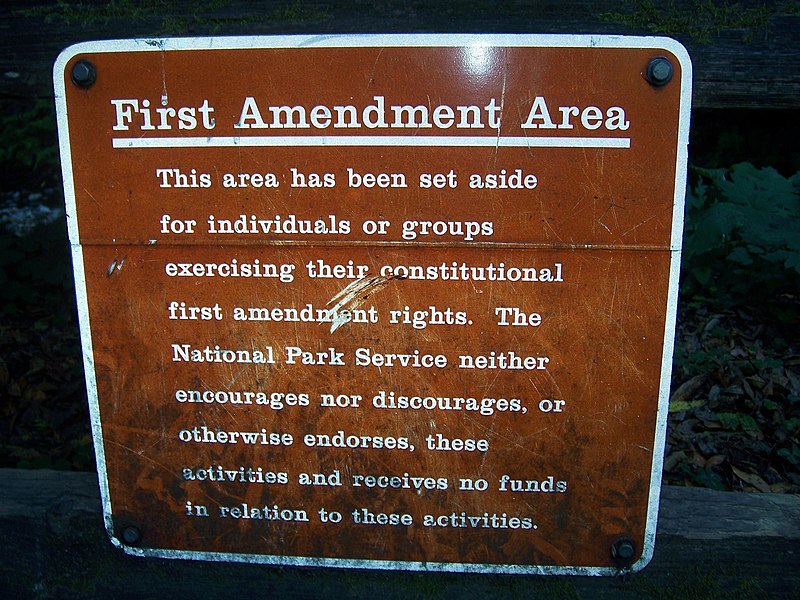
Citizenship, the informed kind, has two distinct angles to it. The first is the personal: We, all of us, have an absolutely inalienable right to the information that allows us to act in a civic and socially responsible way, and Congress shall make no law prohibiting the free exercise thereof. The second is the social: We, all of us, have an absolutely inalienable right to live in a society populated by informed citizens. We have a right to live among an informed citizenry, and any policy, law, or practice that restricts this right exists in opposition to a free and functional democracy.
In America, we embrace the right to informed citizenship; or, more accurately, we shout our support of informed citizenship up to the very rafters. Then we give Big Business a million incendiary devices to burn down that house.
Then there's the kindling, the petrol, the oxygen that keeps the fire blazing. Among the most powerful of these is the news paywall, which sequesters off information to which citizens have an absolute right. In theory, paywalls are no different from their precursors, subscription fees and newsstand prices. But two things have changed--our model of citizenship, and our access to circulated information--since those pre-internet days.
For example: In 1990-1991, during the first Gulf War, news was circulated fairly evenly across multiple platforms. An American who didn't want to pay for a newspaper could still gather information through television and radio. She could walk into a library and read the news for free. Certainly this wasn't a utopian ideal of a free press on every street corner, but the news that enabled a citizen to act was available through multiple outlets.
Today, the speed and reach of internet news sources make them by far the dominant news circulation platform. Indeed, the speed and reach of internet news are part of why a new model of citizenship is emerging. If there was ever a time when it was possible to measure civic engagement by looking at voter turnout on Election Day, that time is long past. Today's civically engaged citizen is the one who is aware of Facebook's abominable approach to privacy and has made decisions about how (or whether) to use Facebook as a result of this knowledge. Today's informed citizen may not know how many electoral votes are needed for a candidate to win the presidency, but she knows how to find that information when necessary. She votes on Election Day, sure, but she also votes with her feet and her eyeballs and her fingertips, constantly making informed decisions about how to parcel out her energy and time, when to dance along with corporate and political influences and when to resist, when to leave the dance floor entirely.
Paywalls make it harder for an informed citizen to stay informed, which in turn restricts my right to live among an informed citizenry. It shouldn't be a surprise to anyone that the news that sticks is the news that spreads--via blogs, social networking sites like Facebook and Twitter, and news aggregating sites like Boingboing. News that's stuck behind a paywall is news that can't spread and is therefore news that dies.
And that's not all: I believe that news paywalls are likely to have long-term effects on citizenship, as well, since I agree with James Seddon's point in his recent Wired article that young people who grow up without unfettered access to local news are likely to grow up without a sense of social and civic connection to their communities.
I recognize that the current business model for print journalism isn't working. I recognize that newspapers need to do something if they want to try to save their jobs. But in America, the eight-year reign of Baby Bush notwithstanding, we don't let business interests trump fundamental human rights.
I'm rooting for newspapers, I really am. I hope they survive this challenge. But news paywalls are in direct opposition to our fundamental right to informed citizenship, and my message to the print media folks is this: Find another way.
I recently participated in a local event called Ignite Bloomington, where my co-presenter, Christian Briggs, and I performed a poem we called "the social beat."
The design of the background images, the development of the poem, and the planning of the performance were all completed collaboratively; this was by far the most collaborative creative project I've ever been involved in. I say that as a graduate of an MFA program who spent three years doing almost nothing but creative work. I say that as someone who intentionally moved away from what I'm coming to see as the antiquated approach to writing that pervades creative writing programs around the country.
I write more now, and more creatively, and with more enthusiasm, than I ever did during my days as a 'poet.' In part, this is because the primary type of writing I do these days is far more public and persistent, and more closely linked to issues that matter deeply to me, than was the writing I did as a creative writing major. But the writing I do nowadays is also more aligned with my ethos: These days, I embrace openness, collaboration, and collective knowledge-building; and producing, circulating, and building upon others' ideas online meets these interests nicely. In fact, this "writing publicly for a networked public" thing meets my needs like gangbusters.
Creative writing, at least in the MFA-program sense of the term, never did meet my needs or interests. It felt too far out of my control. We more or less buy the idea of the "muse"--call it flow if you want, call it the zone, call it whatever you want, but what it means is that we embrace this strange idea that the greatest works emerge when you can set your conscious mind a little bit to the side and let your unconscious break through to the surface. It had to happen in silence. It had to happen alone. And you couldn't control it. You could only control the circumstances that make it more likely to happen.
Sure, fine. We need people to make those great brilliant works by betting on the muse. But that way of thinking about writing is just not for me--it never has been. I'm more into the "how do you get to Carnegie Hall" approach to writing, which is why blogging, and the attendant potential readership, appeals so much to me.
And when it comes to creative writing, I'm kinda into this "collaboration" thing. Coordinating the partnership is tricky and time-consuming, but if you find the right partner you end up standing on each other's shoulders, finishing with something better than any one of you could have written on their own. One thing I know for sure is that the work that came out of my collaboration with Christian is better, stronger, more powerful than anything I could have come up with on my own. I'm proud of this work, maybe prouder than I was of any poem I wrote on my own, and I'm proud to include the poem and a video of our performance of it below.
the social beat {implosion::explosion}
Jenna McWilliams & Christian Briggs
let’s walk it backwards:
when a girl
in a field
face shielded from the sun
looks out at you and smiles
you think something has begun
but that’s not a smile
it’s a grimace it’s a sneer
you’ve got that camera around your face and a 21st century leer
but it’s a circle, a cycle, a snake that eats its tail
explosion, says mcluhan, split the instrument from the wail
and now we’re walking that split backwards to where the hammer meets the nail
to where the language meets its speaker and the face removes its veil
is this a flat world?
a kind world?
a world framed as a game?
what’s the win state?
who’s losing?
should we send it all up in flames?
and with every change we fight for does it all just stay the same?
explosion:
in 1984 papert blew up the school or said computers would
{they didn’t
or if they did, they hid it}
it’s a long revolution
a slow evolution
characterized by dilution and diffusion
and confusion
sometimes, but joy too, and profusion, collusion and elocution
and hope, and motion, and implosion
of space and time and multiple uses
we lifted our tech and it calmly spoke through us.
implosion: the same plane with the same name moves us and rushes us and smooshes us together
that long walkway is us walking away from the everyday pulleys and gears of our years
we climb onto the tech we climb into the sky
we can collaborate now we can elaborate now we can fly
it’s gonna crash
the school becomes a skull
its planks and its floorboards and its chalkboards and its front doors flash past us like shrapnel
as we dash past with laptops
the floor’s falling in and we have them building backdrops and stage props in woodshop.
they’re gonna fall
explode in on themselves, the freight and the chaos
beams buckling, roof knuckling under the weight
as crowds spill like kindling into the street
meeting each other again flinting and squinting again in the sun {ignite}
it’s all going under
it’s all yellow light slanting sideways across shining faces
it’s thunder
it’s traces of ozone it’s acres of blight
as we push back the night as it grinds to a crawl as the old ladies watch and wonder
they’re gonna go under
but the story’s not finished
they’re gonna defend
they’ll never give in. they learned how to stand in an age of their father’s machine.
they’re clean.
so they defend. and they default. and they defer
to the icon and its policies and its politics and its poetry
we automate the manual. now our hands are clean on the path to hell
cue eye roll.
we know how to build, we can do it again. so we build.
and we machinate. and we slap down machines to palliate the children
we fill them as if they were containers.
it’s heinous.
it took two days for those green machines to fill up with guess what? porn.
we’ve had millennia now of dissemination, maybe it’s time to change the story
to disovulation: one perfect idea at a time, sent out into the world
then we’ll let you guys fight over who gets to claim it.
or blame it.
millennia now of the Churchills the Hitlers the Gateses the Jobses the Spitfires and Messerschmittses and Habermas and Hobbeses
like a girl
in a field
face shielded from the sun
is still inside the lines
where something has begun
it’s the circle, the cycle, the snake has caught its tail
the explosion’s moving backward though the timid first will fail
the tots will test it, resisting with a poke, a prod, a post
the slightest and the smallest seem the most benign of rabble
filling up the tubes with what will mostly seem a babble
to defenders of the past
now they’re teens
on the street
the lines are giving way
babble turned to business
as the structures start to sway
but still defenders are within this
scene, clutching for the days….
that will no longer be..
you see…
the teens have grown and jumped the lines
we’re not walled in and not walled out
nor confined by any doubt
instead we clamber for the time
when all that’s in will all be out
a coalescing of the minds
whose synaptastics speed the time
technology will take its place
a toy a tool connecting us
aiding a collective us
crushing in both time and space
freeing up the play in us
we are those girls
in our fields
faces turned toward every one
collectively reflecting on the
thing that has begun
or is it ending as it rends us?
the scream igniting as it mends us?
unbends us and upends us:
a lick of flame, a bonfire, night brought shrieking to the sun
a slow sermon whispered softly:
there is much that must be done.
Monday, March 8, 2010, is International Women's Day, and Gender Across Borders is helping to get the word out by asking people to blog on this year's theme: “Equal rights, equal opportunity: Progress for all.”
Today is the one-year anniversary of the establishment of this blog. I count my decision to start this blog, and after that decision the decisions to cultivate it, populate it, and spread the word about it as the most significant aspect of my developing identify as an academic.
And I don't mean "academic" in the stuffy, yes-quite kind of way, either. I mean that the decision to start this blog--a decision that came suddenly, without much by way of any warning--was a decision to speak. It was a decision to move from "Yes, that's something I care about, and I wish there was something I could do about it" to "Yes, I care about that, and here's what I think about it and here's what I'm doing to change things."
I love blogging. It has opened doors for me. It has allowed me to say things I wouldn't have otherwise had the space to say, to people I want to hear those things. And if I sometimes go a little overboard on extolling the virtues of blogging, it's only because I hope for everyone to experience a similar falling away of the weights and chains that for so long kept me close to the earth.
I have a dim memory of the person I was before--a much smaller, much timider person who was horrified at the prospect of taking up too much space or too much of your time. I know that version of me is killed for good, and I'm glad for it. I hope that all of you have the chance, at least once, to experience this kind of total transformation. I hope you get the chance to experience the power of some tool, some network, some community, some practice, online or off, to change your life and trajectory and goals and plans for good.
In case you're looking for some last-minute gifts for the bloggers you know, I offer the following products designed to show how much you love and value their work in that nebulous place we call the blogosphere.
T-Shirts, stickers, and mugs
I actually don't know many bloggers who would wear T-shirts advertising their blogging practices. I'd probably be more likely to wear a T-shirt that advertises my blog's URL than I would to wear any of the shirts below, but on the other hand, I'm a big fan of the last two designs.
Mugs for bloggers, by zazzle.com. At the risk of stereotyping: If there's one thing bloggers use, it's mugs.
Cafe Press gifts: T-shirts, stickers, and mugs. These are fairly clip art-looking, but there are some gems in the pile. There are also some clunkers, exemplified by this kid's hoodie encouraging caffeine addiction and antisocial behavior, if the imprinted message is to be believed:
Happiness is...
Your favorite pen
a great plot line,
a hot cup of coffee,
and an entire day alone.
Gift Lists from Elsewhere
Ten Great Gifts for Bloggers and New Media Moguls, by Catherine-Gail Reinhard (Mashable.com). I offer this link even though I think only eight of the ten gift ideas proposed in this article are actually useful for your typical blogger / new media mogul. Idea #2, a laptop hideaway, is basically a $50 paperweight since no blogger worth her salt actually chooses to or even wants to stow her laptop out of sight. Suggestion #8, typewriter jewelry, is perhaps useful for some bloggers, but others of us spend so much time stuck to a laptop that we don't have time for things like personal adornment and / or hygiene.
50 Perfect Gifts for Webophiles, Bloggers, and Internet Marketers, by SEOmozBlog. This list is fairly gadget-heavy, with several desktop toy-type items (including the Cranium Poindexter doll at right). In my experience, bloggers tend to lose / drop / break things with a fair amount of frequency, so exercise your good sense here. I do like the emphasis throughout this list on gadgets that can clean / feed / organize the typical webophile.
Gadgets for Geeks, from Skimbaco Lifestyle. This list is exactly what the title suggests: a short list of a variety of geeky gadgets, including clocks, quirky USB drives, and the Kindle.
HoMedics Shiatsu Back Massager This is a must-have for any blogger. Well, okay, it's a must-have for this blogger. I tried one of these at a local pharmacy the other day and I almost slid out of the chair. I was JUST THAT RELAXED.
Below are my nominations for the 2009 Edublog Awards. If you're interested in submitting your own nominations for this year's awards, you'll need to act fast. The deadlines start rolling in this week:
Nominations: Close Tuesday 8 December
Voting: Ends Wednesday 16 December
Award Ceremony: Friday 18 December
Click here for more information about the awards and nomination process.
Best individual tweeter: Alec Couros. (Couros is a professor of educational technology and media at the Faculty of Education, University of Regina. He's a regular tweeter who engages with a range of topics and with other twitter users; his tweets are informative and the links he offers to his followers are always interesting.)
Best resource sharing blog: Open Education News, a site that aggregates information about research, materials, and news about the open education movement.
Most influential blog post: a few notes about openness (and a request), by David Wiley. This post hits on a key tension within the open education movement: How do we define openness? He writes:
First, “open” is a continuous, not binary, construct. A door can be wide open, completely shut, or open part way. So can a window. So can a faucet. So can your eyes. Our commonsense, every day experience teaches us that “open” is continuous. Anyone who will argue that “open” is a binary construct is forced to admit that a door cracked open one centimeter is just as open as a door standing wide open, because their conception of the term has no nuance. Alternately, they may adopt an artificial definition, in which a door opened 20 cm or more is considered open, while a door opened 19 cm is not considered open. But this is unsatisfactory as well.
Wiley has since addressed the question of openness in a systematic, deliberate, and useful way; but I consider this post more influential than even the ideas it gave rise to because it so clearly delineated the problem and so clearly demonstrated (in the tone of the post and in the comments below) the emotional tension underlying this issue.
Best teacher blog: Kevin's Meandering Mind, a blog maintained by Kevin Hodgson, a 6th grade teacher, National Writing Project teacher-consutant, creative writer, and author. It's absolutely essential reading for anybody interested in questions about how we might teach the "new" writing.
Best educational use of video / visual: viz.: Visual Rhetoric -- visual culture -- pedagogy.
I've been following technorati's 2009 state of the blogosphere report with the level of interest you might expect from someone who spends the vast majority of her free time blogging. Much has been and will be made of the following statistics, culled from technorati's survey:
• Two-thirds are male • 60% are 18-44 • The majority are more affluent and educated than the general population ◦ 75% have college degrees ◦ 40% have graduate degrees ◦ One in three has an annual household income of $75K+ ◦ One in four has an annual household income of $100K+ ◦ Professional and self-employed bloggers are more affluent: nearly half have an annual household income of $75,000 and one third topped the $100,000 level • More than half are married • More than half are parents • Half are employed full time, however ¾ of professional bloggers are employed full time.
These statistics are worth mulling, as they point to a disturbing trend toward the mainstreaming of what was previously a counterculture form of communication. Others have begun exploring this in depth.
What interests me most at the moment, however, is the statistic on journalistic credentials. According to the report, 35% of respondents have worked in traditional media formats, including newspapers and magazines, radio, and television. Compare this to the less than 1% of the entire American work force employed in traditional media fields.
And one more statistic before we dive into analysis: Of those who identified as having employment history with traditional media sources, 72% are no longer employed by a media outlet. This means that just over one-fourth of the bloggers surveyed are formerly affiliated with traditional media outlets.
Why does this matter? Because it points to two interesting and important trends among bloggers: They have had more exposure to traditional journalistic ethics than does the average American; and they are disproportionately drawn to blogging as a news circulation format. This is, in my view, a double smackdown to those who fear that the shift away from traditional news sources will lead to a decreased quality in reporting.
journalistic ethics, carried over As I've explained before, I'm a former newspaper reporter whose paper folded after a long slide toward decreased advertising revenues. Not all of us who worked at that local paper were journalists, exactly--our crew included two sales reps, two assistants, a circulation manager, and various part-time employees--but everybody at that office embraced a deep commitment to honest, responsible information delivery. It kind of came with the territory.
Journalism is guided by an ethical framework--what we might call an appreciative system--that's undergirded by intellectual rigor, critical curiosity, and chronic curmudgeonry. Though this commitment is move visible in its breach (which is in part why Jayson Blair became a household name), it's a big piece of what drives so many people into traditional journalism even as its dying gasps turn into death rattles.
disproportional representation: paid journalists become voluntary journalists Old journalists never die, they just get de-pressed, har har. In fact, the thriving popularity of blogs and their potential to reach a vast--indeed, potentially almost infinite--audience is by my lights part of what draws us traditional media curmudgeons to new media. Though I can't speak for all traditional media-affiliated bloggers, I can tell you that I was drawn to journalism because I believed in its power, believed in its transformative potential. I believed, even before I could articulate it, in the power of a free press in a democratic society. That's free as in speech, not as in beer.
Now, as a blogger, my understanding of "free press" has changed: When I talk about the power of a free press, I now mean free as in speech and as in beer. This does not, contrary to commonbelief, mean that I believe we can sustain a thriving communication system without funds; I just don't believe that the people should be required to pay for information. I have elsewhere delineated between 'news' and 'the news' and discussed various approaches to funding that may be more sustainable than the current system, so I won't go into that here; instead, I only want to submit that for many traditional-media types like me, blogs offer what a career in journalism did, only more so. More communication of ideas, more potential readership, more opportunity for direct conversation between the writer and her readers. News can be broken, immediately, to overwhelming impact, via blogs; ideas can be offered, discussed, and modified; a reading public can be mobilized to act.
There are those who will (and do!) argue that unpaid citizens will never be willing to commit to reporting on local, national, or international news without pay; or that even those who are willing to do so will offer substandard, biased, or useless content. These charges may be true, but only of a subset of the online journalistic population. For the rest of us, our commitment to delivery of high-quality, well researched and useful information has never been higher or more valuable--essential, really, to a democratic society built on a presumption of freedom of speech and of the press.
In my search for interesting new blogs to follow, I recently realized I could easily crowdsource this search to the Twitter community, assuming I could get enough users behind it. Twitter users have leveraged the #followfriday hashtag for recommending follow-worthy users and #musicmonday to offer musical suggestions, to roaring success.
I'm going to try starting a #blogroll hashtag, intended to share interesting blogs with other users. I think this will work best if the blogs are grouped by category, so that people who search #blogroll will be able to sort by their interests. So a #blogroll tweet might look like this:
If this works for you guys, then perhaps we should choose a day. I nominate Wednesdays, since for some reason that's the day I most often find myself looking for new blogs to read.
I've been accused, off and on, of being a technological determinist. I'd just like to point out, for the record, that the five most common terms I've used are, in order or frequency:
new
media
people
like
social
Emphasis on the social effects of new media for people who like stuff FTW.
more thoughts on blogs as tools for teaching and learning
If we're going to think seriously about how to use blogs as tools for teaching and learning, it seems to me that it may be useful to differentiate between crafting a successful blogpost, developing a successful blog, and being a skilled blogger.
Successful blog posts Here's an example of a successful blogpost, on a blog called "neologophilia," that identifies a gulf between the new National Writing Standards and the actual skills required to write well: We Interrupt This Writing Process... It's a smart, well supported, and articulate argument, supported effectively through the use of hyperlinks and development of ideas; but the blog itself appears to be dead in the water: The writer published only seven posts in eight months (all of which were excellent, btw), and the last post went life a full two months ago. No audience has the patience to stick around through gaps that big.
Successful blogs Here's an example of a successful blog that contains a mix of successful, moderately successful, and far less successful posts: Ironicus Maximus, which uses as its anchor this quote by the Rev. Ray Mummert: ""We've been attacked by the intelligent, educated segment of the culture." The bog focuses on politics and social issues, attacking lameness with irony and precision. It's one of the smartest, wittiest, and most subtly hilarious blogs I've read, and the author has kept it running for over four years. Not every post is of equally high quality, but when you're tossing up an average of just under 240 posts a year, you get some wiggle room in this respect.
Skilled bloggers Here's an example of a skilled blogger: Media Nation, run by Northeastern University journalism professor Dan Kennedy. Kennedy keeps a clean, well ordered, and regularly updated blog, and it attracts a wide and active reading public. Because of his relative celebrity as a media analyst (and his participation in a range of communities, including writing for The Guardian, CommonWealth Magazine, and the Boston Phoenix), he gets some of his readers for free. But Kennedy also works hard to cultivate his readership. He posts regularly, responds to nearly every comment on his posts, and places himself squarely inside of a network of blogs and bloggers who write and think about the issues he grapples with. He serves as an ideal intelligent filter, pointing readers to links of potential interest both in his blog and through his Twitter feed.
Kennedy has built his growing readership by going far beyond shamelessly trolling for readers. He offers himself up as a trustworthy source for others and refuses to engage with the traditional broadcast style of reportage that news sites and some blogs still promote. In short, Kennedy is a skilled blogger because he understands and engages with the largely unspoken norms of being a blogger.
Lots of really good blogs are maintained by people who publish beautiful, articulate, and engaging posts but clearly miss the boat when it comes to the norms of blogging. Being a skilled blogger takes time, and not all of that time is devoted to simply drafting new blogposts. Skilled bloggers engage with other blogs. They read like crazy, comment like crazy, hyperlink like crazy. They feel a deep responsibility to their reading public and to other bloggers within their thematic sphere. They're self-promoting fiends, sure, but they also promote, criticize, and filter the ideas of others.
In a future post, I plan to explore how four different types of engagement--procedural, conceptual, critical, and consequential--align with the requirements for publishing a successful blogpost, keeping a successful blog, and being a skilled blogger; for now, because this post is getting way too long as it is, I want to offer a provisional description of the features of each: Features of a successful blog post
A well organized argument or main point, supported through the use of hyperlinks and multimedia materials (video, sound, images)
A clear, unified voice that is appropriate for the intended reading public
A title that links clearly to the content of the post
Features of a successful blog
Short, concise posts that use multimedia materials (video, images) to effectively make a point
Effective use of hyperlinks to support ideas, to direct readers to relevant, interesting posts, and to demonstrate an awareness of the community of writers focusing on a common theme or set of ideas
A clear, unified voice that continues to grow and develop over time
Qualities of a skilled blogger
Ability to quickly synthesize and articulate ideas
An awareness of a wide range of blogging techniques and of how these various techniques reach different target audiences effectively or ineffectively
Reading with mouse in hand: Engaging with (online and offline) materials as potential material for blogposts
Willingness to serve as an intelligent filter for a wide public audience
Engagement with the wider blogging community, including offering thoughtful comments on others’ writing and reading widely and broadly
This is far from an exhaustive list, and I'd love to hear your thoughts on how to build on, reshape, or refine the categories above. My next post, I'm pretty sure, will focus on assessment strategies across these categories--so input would be most welcome.
I'm hoping to crowdsource some brainstorming about the pedagogical potential of blogging on learning. Lately, in my work with Dan Hickey's 21st Century Assessment Project, I've been thinking tons about how integrating blogging in the formal English / Language Arts classroom might build a rich new media environment for ELA students. I've started a provisional list below but am hoping that others (most importantly for me, people who have worked with blogs in their classrooms) can offer ideas for additions to this list.
First of all, it's worth noting that my approach to the value of blogging for teaching and learning in Language Arts is deeply informed by the work of a number of teacher-researchers from several fields. Most notable among these are Paul Allison, whose chapter "Be a Blogger: Social Networking in the Classroom" (in Teaching the New Writing: Technology, Change, and Assessment in the 21st-Century Classroom, by Anne Herrington, Kevin Hodgson, and Charles Moran) offers a glimpse into the day-to-day workings of a blogging-focused ELA curriculum; and Sam Rose and Howard Rheingold, who have devised (and made publicly available) an enormous set of resources for teaching in and through new media platforms.
My approach is also informed by my personal experience as a blogger--really, to be fair, as someone who is willing to squeeze out nearly anything in order to make time for posting. By even my most generous estimate, I spend far too much of my time blogging--unless you account for the formative value of blogging for someone like me. I am convinced that the intellectual and identity work required for me to maintain this space has led directly to my growing prowess as a researcher, reader, and writer. You cannot convince me otherwise; so do not even bother trying.
My experiences and the reading I've done about the value of blogging for learning informs everything that comes next.
Characteristics of blogging that support new media literacy
Reaching a wide(r) reader base It's important to note that blogs differ in purpose from many seemingly similar writing platforms. It's obvious to most that a blog is different from a personal journal, in that while many of us may hope to have our journals read by a larger public some day, blogs are actually intended to support wider readership. The majority of blogs are public (meaning anybody can view them) and taggable, and they come up as legitimate sites in web searches.
Blogs also differ from forums, chat rooms, instant message programs, and social networking sites like Twitter and Facebook. Of all of these spaces, blogs are generally the most polished, the most text-based, and the most supportive of extended engagement with a single idea. Shifting from intended audience to intended public This idea is ripped from Howard Rheingold, who (tapping into some Habermas) writes that
[m]oving from a private to a public voice can help students turn their self-expression into a form of public participation. Public voice is learnable, a matter of consciously engaging with an active public rather than broadcasting to a passive audience.
The move here is away from the "please read what I wrote" approach to "please act on the ideas I've written down here." The regular practice required for building and maintaining a blog's readership helps to crystallize this shift and helps writers to see there is a broad, if constantly shifting, group of people whose interests align with the broad, if constantly shifting, ideas of a blog. Though the intended public is largely invisible (we have generally only met a fraction of our blog's readers), consistent practice in finding, drawing in, and engaging this target public makes them less transparent.
Blogs as (genuine) conversations When I taught college composition lo these many years ago, I always tried to argue to my students that all writing is a conversation--that when we write, we take up ideas that were presented by other writers before us and try to present something new that might be of interest to people who care about the kinds of things we write about.
The argument always felt hollow to me. After all, college students are typically only eavesdroppers. Only a handful of people will ever read what they've written, and often the students don't really care all that much about the assigned writing topics anyway. Add to that the artificial motivator of the ever-elusive 'A' and you have a recipe for calamity.
But blogs--now blogs are authentic communication spaces. They really are. Anybody can get almost anybody to read a blogpost and, if the post is engaging enough, to comment on the post for all eternity to see. This very fact ups the ante some: Getting the spelling of someone's name suddenly matters an awful lot. Making a concise, well supported argument has real, potential consequences: A strong enough argument gets people to sit up and notice. A strong enough argument gets people to act. A move toward increasingly public spheres of participation An increasingly participatory culture calls for participation that's ethical, reasoned, and publicly accessible. After all, the widespread takeup of the spirit of participatory culture requires that we all act in ways that keep the barriers to participation low, the potential for contribution high, and the mentorship possibilities readily available to most or all participants. This can only happen to the extent that all or most of us are willing to operate, to express and circulate our ideas and creative works, in public online and offline spaces. Since so much discourse will increasingly happen in public spaces, it only makes sense that we use the ELA domain to prepare students for engagement in those public spaces.
Blogs as spaces for fostering both traditional and new media literacies For language arts teachers, blogging presents a fairly obvious avenue for preparing learners for engagement in public spheres of communication, since blogs align nicely with the traditional purposes of the ELA classroom. As a group of readers engage in deep analysis of their own and others' blogs, they have to think about issues like tone, style, genre, punctuation, word choice, and organization.
The extra toy prize is that students also get to learn about the characteristics of online writing, including what danah boyd identifies as the four properties of online communication (persistence, searchability, replicability, and scalability) and three dynamics (invisible audiences, collapsed contexts, and the blurring of public and private). As my colleague Michelle Honeyford put it, "they hit all the standards and get to learn about online participation for free."
Confronting the ethics challenge Nobody's arguing that we should sign every sixth grader up with a Blogger account. That would just be silly. Media scholar Henry Jenkins is fond of saying that the role of educators and parents is not to look over kids' shoulders but to watch their backs, and scaffolding learners toward participation in increasingly public spheres allows us to do just that. Lots of teachers (including the famously brilliant Becky Rupert at Bloomington's Aurora Alternative High School) start their students out by having them post to a private space (she uses Ning) but having them analyze writing from more public spaces. This way, they have a kind of new media sandbox to try out and engage with the norms of online communication before actually being held to the higher ethical standard, with deeper potential repercussions (both positive and negative).
That's all I have for now, though I would love to hear from you on the list above. What have I missed? What am I ignoring? What struggles are linked to bringing blogs into the classroom, and what challenges have you encountered if you've tried to do so?
I hope for this to be a multipart post that will include thoughts on the following categories:
Affordances of blogging as a new media writing technology
Challenges to integrating blogs into the ELA classroom
Resources (including lesson plans, other writing on this topic, etc.)
Assessment guidelines for working with blogs
If you have thoughts on any of the above, I'd love to hear from you. If you have any trouble posting comments (I don't know why, but some of you have) please email me at jennamcjenna(at)gmail(dot)com.
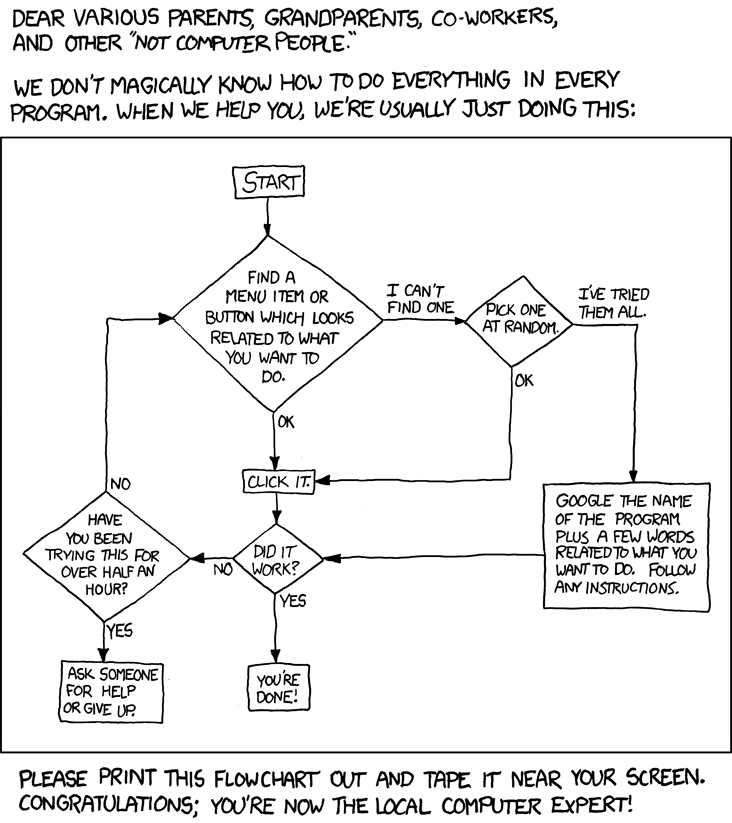
Funny, right? Har har har. But it's worth thinking about why some people (generally younger, generally more immersed, more regularly, in new media technologies) feel comfortable tooling around in a vaguely solution-oriented sense, while other people (generally older, generally less immersed, less regularly, in same technologies) see their computers, cellphones, and other tools as impenetrable black boxes whose functions exist in a mysterious, perhaps dangerous ether.
This morning I had the awesome experience of hearing educational researcher and recently minted Indiana University Ph.D. Tyler Dodge talk about his research into new media, visual realism and empathy. He presented a version of the following diagram (which I have helpfully built upon with a small set of descriptors). The basic idea is that new media can be designed along two distinct continua: interactivity and immersion. Put briefly, Tyler argued that high interactivity + high immersion = awesomeness.
Tyler added that high interactivity with low immersion leads to frustration. It's what I feel when I work with the visual programming language Scratch; it's what other people feel when they look at the Twitter interface; it's what still others feel when faced with this:
I know doing something will make something happen, we think in the various contexts that make us feel like a fish gaping in an empty bucket, but what am I supposed to do? And what will happen when I do it? What will happen if I do it wrong?
I know the feeling. I know it, though computer- and internet-based troubleshooting doesn't trigger it in me--yet. My day will come, I suppose. Oh yes, it will come. So too much hubris now probably doesn't pay.
writing professionally and well takes time and that most authors need to be paid to take that time. In this regard, blogging is not writing. For example, it's easy to be loved as a blogger. All you have to do is play to the crowd. Or you can flame the crowd to get attention. Nothing is wrong with either of those activities. What I think of as real writing, however, writing meant to last, is something else. It involves articulating a perspective that is not just reactive to yesterday's moves in a conversation.
Far from challenging either the notion that "writing meant to last" is not "just reactive" or that blogposts are somehow just reactive and not meant to last, Quesada agrees with Lanier's stance and adds that
[a]ll academics are painfully aware that writing well takes time, and some know that writing well is not a prerequisite for having a successful blog.
So, basically, it doesn’t pay off to painfully slowly distill ideas for a blog post. In a sense, consuming blog posts –let alone microblogging 140-character blurbs- warrants you a so-so level of refinement.... Playing to the crowd –what bloggers must do, according to Lanier- does not require incredibly solid thinking; it’s a completely different skill.
Truly, I've had enough of this outdated stance with respect to blogs. It's worth pointing out that Lanier's essay dates back to 2006--eons ago, from the perspective of the social revolution. Here in 2009, blogs have come into their own as spaces for serious engagement with serious ideas. (Author update 9/27/09, 11:18 PM: Not to press too hard on this issue, but Lanier's essay is so outdated that it refers to Wikipedia as "the Wikipedia"--not once, not twice, but twenty-one times. Just imagine the alternate universe where we talk about looking up information on the Wikipedia--akin to tweeting on the Twitter or posting a new status update on the Facebook. That would make for a very different the America, that's for sure.)
Academics have embraced the platform in a variety of ways. Media scholar Henry Jenkins uses his blog for presentation and exchange of serious ideas. Over at the Tiger Beatdown, Sady Doyle takes on the outrages of a deeply sexist society with a playful tone (she explains her blog is about "ladybusiness") that only heightens her deeply effective expression of rage. HASTAC co-founder and Duke University professor Cathy Davidson uses her blog to work through key issues (social media, literacy practices, academia) in an informal, inviting, colloquial tone. Though I've only offered three examples, academics are in fact embracing the weblog in their own interesting ways by the dozens--by the hundreds, perhaps by the thousands.
Quesada argues that "blogging will do nothing in an academic CV." I couldn't disagree more. While it may be true that blogposts don't yet count as "serious" academic discourse on par with publication in peer reviewed journals, not having a blog is increasingly a glaring omission, especially for academics who are or should be focused on the role of social media within their discipline (which is to say just about every academic).
Career advancement issues aside, Quesada seems to be arguing that producing thoughtful, intellectually challenging blogposts is not a productive enterprise for academics--that if they choose to blog, they should use it to reach a popular audience instead of using it to present deeper intellectual work. "What I think could work," he writes,
is a hybrid between a focused paper (that nobody would read other than a close circle of scientists) and a blog post that ‘plays to the masses’ and tries hard to capture attention at the cost of rigor and polish.
(Shut up! the blogger in me wants to holler. At the cost of rigor and polish? Do you even read any academic blogs? *cough* *sputter* ::regains composure::)
One of the most significant obstacles to intellectual progress is the difficulty of getting interesting but new or untested ideas circulated among other thinkers--academics and non-academics alike. This is especially true for young academics (like me!) who have an awful lot to say but neither the credentials nor the years of research to back up their ideas. My work in maintaining a blog--and using it to present ideas that I think are both rigorous and fairly well polished--allows me to not only offer up my thoughts for examination by thinkers whose opinions matter to me, but also to refine, build on, or dismiss ideas based on input from others. (I got Ted Castronova to comment on my blog!) Further, when other academics whose work I admire keep a blog, I have the opportunity to weigh in on and perhaps contribute to their ideas. (I get to comment on Henry Jenkins' blog!)
In short, academic blogs drop the barriers to participation in productive, valuable and meaningful ways--and the more seriously academics take this platform, the more likely it is that blogs will increase in significance (and, incidentally, upping the odds that blogging will come to mean something on an academic CV).
We would do well to remember that academic productivity is about much more than finding ways to get your work done efficiently. It's also about being a productive member of a larger community of thinkers and researchers, all of whom benefit from the wider circulation of more ideas, from more people, in more participatory ways.
a form of blogging for which the medium is video.Entries are made regularly and often combine embedded video or a video link with supporting text, images, and other metadata. Entries can be recorded in one take or cut into multiple parts.
The open content site at public radio station WGBH clumps vlogs with blogs and offers one definition for both; presumably, this means that both offer the same kind of content, using different media delivery formats.
In that case, here you go: my very first vlogpost, a video project (filmed and edited by me!) explaining how I read and write through my primary identity as a blogger.
Over the last few months, I've largely kept my "print-media-isn't-viable" soapbox stowed out of public view. A new post by Northeastern University journalism professor Dan Kennedy got me lugging it back out.
Kennedy, a long-time subscriber to the Boston Globe (which he calls--and I agree with him--"the most important news organization in Greater Boston"), has decided to cancel his Monday through Saturday subscription. He writes:
Why did we do this? It’s been inevitable since early this summer, when the Globe made a couple of important changes in its distribution model. First, it unveiled GlobeReader, an electronic paper that’s a faster and easier read than the Web edition. Second, it raised the price of its print edition.
Seven-day home delivery of the Globe now costs $46.56 a month in Media Nation. With advertising in what may be a permanent decline, readers are going to have to pick up more of the cost, so I certainly don’t fault the Globe for charging more. But our family is not immune from economic pressures. For us, it makes sense to go with paper on Sundays and use GlobeReader the rest of the week.
Kennedy, like all of us who consider a thriving, free press to be the backbone of a thriving, free society, explains that he has struggled with his family's changing relationship to his local newspaper. He justifies the change with his subscription to the Globe Reader (it costs $14.95 a month it comes with subscription to the Globe--thanks for the correction, Dan) and explains that he would not have canceled his subscription if the only alternative were reading the news online, because
[l]ike virtually all newspapers, the Globe is struggling with its decision some dozen year ago to offer its content online for free. At one time, newspaper executives assumed that advertising revenues would eventually justify that decision. It didn’t happen — it may never happen — and the way out of that morass is unclear. We were not about to contribute to that pain.
Though Kennedy makes no judgment here about the net value of making news content available for free online, there are those who do, who have, and who will. I am one of those people. I believe that the decision to make news content available for free online is perhaps the single most crucial factor leading to the social revolution.
Imagine an alternate scenario: back in the 1990s, at the very beginning of the internet age, news executives decide to charge--and even a micropayment will do, for this scenario--for access to online content. Communication, creation, and circulation of individual ideas and creative works are still cheap or free, as they are today, but accessing the news will cost you. In this scenario, the power of the hyperlink gets diluted to practically zero, at least for those who choose not to pay for their news. Blogging loses its widespread appeal. Social media platforms like Facebook and Twitter, if they even come into being, get relegated to the realm of the banal: tweets about what I had for breakfast, status updates spreading my results on a series of meaningless quizzes, achievements in Mafia Wars and Scrabulous.
It's tough to imagine this alternate universe because putting a price, even a tiny one, on access to content seems nearly unthinkable to us now. Indeed, perhaps the most significant fallout from media executives' decision not to charge for content is the general public stance exemplified by Jon Stewart's comment to Walter Isaacson, a journalist and policy guy who believes newspapers should start charging for access to online content: "Sir," Stewart said in disbelief, "the internet is free."
Since the advent of mass literacy, has there ever been a time when so many people believed so strongly that information should be free and accessible to all?
Alert blogtrollers may have seen multiple posts recently with titles identical to the one accompanying this post--that's because we've been asked by learning scientist and new media researcher Kylie Peppler to address this very concern. The question--what is learning in new media?--is too broad for anyone to address within the context of a single blogpost, but if we all set to work, we might get that turkey stripped down to its bones by the end of the night.
My chunk of the turkey is time.
When I joined Twitter, I lurked for months and months without tweeting a thing. When I finally did join the community as a good, earnest citizen, I started out slowly and picked up speed as I learned to negotiate the community's norms and embrace the valued practices of the space. Now, a year and a half later, I can communicate fairly clearly the spoken and tacit norms of the Twitterspace.
I did the same thing with Facebook, Wikipedia, and blogging--looking around for months before joining the community. By doing so, by taking the time to consider the space I was entering, I was able to reflect on others' practices before offering up my own. I read thousands of blogs before starting my own. I worked with friends to learn how to edit Wikipedia. And I was coerced by another friend to join Facebook; the rest was up to me.
I recently spent some time working with Scratch, a simple visual programming language designed for young learners. As the site explains,
Scratch is designed to help young people (ages 8 and up) develop 21st century learning skills. As they create and share Scratch projects, young people learn important mathematical and computational ideas, while also learning to think creatively, reason systematically, and work collaboratively.
I've designed exactly two projects in Scratch; the first was about a year ago, when a colleague spent the morning helping me work up a little thing I call Jimmy Eats World.
I'm annoyed with myself that I didn't make the flying hippo actually disappear at the end of the project, and if I wanted to I could open up the program and make it so. Or I could turn the main sprite, the walking cat, into a hammerhead shark announcing my blog's url.
I could do that if I wanted to, because I am a highly resourceful independent learner who has the passion and the time to devote to projects like this. I find them personally and epistemologically meaningful--I feel enriched, and I feel that the time I devote to these kinds of projects makes me a better, more useful and proficient blogger and educational researcher.
Time, the friend of the highly resourceful learner, is the enemy of teaching. Time: There's never enough and even if there were, it couldn't be spent on tinkering. There's content to cover, and not just in the name of high stakes tests. A teacher's job--one made ever more challenging by the social revolution--is to equip learners with the knowledge, proficiencies, and dispositions that will suit them well for future learning. There comes a time when the teacher must say, It's time to stop with Scratch and start on something else.
Which is a deep shame, because it's the tinkering, the ability to immerse oneself in participatory media or a learning platform, that fosters a real fluency with the space.
This is a key feature of what it means to learn in new media: the choice to engage with certain tools, to join up with certain affinity spaces, beyond the time required by schools. Clay Shirky writes that the days are gone when we could expect to do things only for money; we're in an era when the greatest innovations emerge not for money but for love.
If learning in new media takes time, passion, and some combination of intrinsic and extrinsic motivations, then on its surface school seems to run anathema to a new media education. In fact, it may be that engagement with participatory practices is exactly what schools need at a time when they are struggling to remain relevant to the real world needs, experiences, and expertises into which learners will ultimately emerge.
The post itself is the result of a Twitter exchange wherein one of Henry's followers, @aramique, wrote: "you theorize on participatory models over spectatorial but i've noticed your whole twitter feed is monologue." Ultimately, Henry responded with this: "yr questions get Twt's strengths, limits. but answer won't fit in character limits. Watch for blog post soon." Then, in his blogpost, he begins with this:
I will admit that there is a certain irony about having to refer people to my blog for an exchange that started on Twitter but couldn't really be played out within the character limits of that platform. But then, note that armique's very first post had to be broken into two tweets just to convey the emotional nuances he needed. And that's part of my point.
From the start, I've questioned whether Twitter was the right medium for me to do my work. I've always said that as a writer, I am a marathon runner and not a sprinter. I am scarcely blogging here by traditional standards given the average length of my posts. Yet I believe this blog has experimented with how academics might better interface with a broader public and how we can expand who has access to ideas that surface through our teaching and research.
Jenkins, who makes it clear that his blog is his primary focus for online communication and that Twitter is a space for him to both direct traffic to his blog and track who follows his links, and when, and how, argues that though Twitter has its value as a social media platform, it has resulted in some losses. His main concerns are linked to a core issue with the key feature of Twitter: its brevity. As it grows in popularity, he explains, deep, thoughtful commentary on his blogposts has decreased:
Most often, the retweets simply condense and pass along my original Tweet. At best, I get a few additional words on the level of "Awesome" or "Inspiring" or "Interesting." So, in so far as Twitter replaces blogs, we are impoverishing the discourse which occurs on line.
"[I]n so far as people are using (Twitter) to take on functions once played on blogs," he writes, "there is a serious loss to digital culture."
I guess I'm approximately as serious about blogging as a medium as the next guy who posts tens of thousands of words each month, but I'm not sure I share Henry's concern. There were, after all, those who worried that blogs would lead to the decline of serious and thoughtful intellectual conversation. But as Henry's blog (and hundreds or thousands of others like it) demonstrates, blogs can in fact afford both a higher level of expression and a greater capacity for circulation of those ideas. The phenomenon of the blog also--and this was a key element of the initial concern about the decline and fall of civilization at the hands of the weblog--means anybody with internet access, basic typing skills, and a couple of ideas about anything at all can express, post and circulate them. Blogs even support cirulation of the most ignorant, repulsive claptrap a person can imagine. The onus is therefore on the consumer, and no longer the producer, to filter out the white noise in search of real music. The fear, real or imagined, was that the general public would not be able to filter intelligently and would therefore accept any nonsense they read online.
Actually, this fear is not a new one. The same anxiety was prevalent among educated elites when the universal literacy movement began to take hold. It was the same fear that gripped members of "high culture" when movies, then radio, then television, then YouTube became increasingly popular and available. See, that's the peculiar feature of democratizing technologies: Elites no longer get to decide what's culturally valuable and filter it out before it reaches the unwashed masses. Now we all get to decide, and that's precisely what leads the privileged class--even members of this class who are pro-democracy--to react so strongly that they try to stamp it out.
It's the same cry I hear from people who oppose Twitter: There's so much meaningless noise. It's leading to a decline in critical thinking. Jenkins writes that
there is an awful lot of relatively trivial and personal chatter intended to strengthen our social and emotional ties to other members of our community. The information value of someone telling me what s/he had for breakfast is relatively low and I tend to scan pretty quickly past these tweets in search of the links that are my primary interests. And if the signal to noise ration is too low, I start to ponder how much of a social gaff I would commit if i unsubscribed from someone's account.
Twitter, for all its seeming triviality, is one of the most complex, nuanced social media environments I've ever participated in. It's layered over with the kind of community expertise required for authentic, valued participation in a vast range of social networking sites, both online and offline. Add to that the fact that Twitter users bring to their engagement with the site any number of social motivations; multiply that by the nearly limitless number of possible subsets of Twitter followers the typical user might communicate with; and square that by the breathtaking creativity that the 140-character limit both supports and fosters.
This is what's most difficult to explain to a new Twitter user, and what's nearly intuitive for those who have internalized the tacit norms of the space: No tweet can be interpreted in isolation. No Twitter stream exists wholly independently of any other. Twitter's depth exists precisely in the delicate intertwining of inanity with complexity. Yes, most of the time I skip over people's breakfast tweets. But I don't always skip over them. Much of the time I click on the links Henry posts. But I don't always click on them.
Sure, Twitter is no substitute for a series of deep, thoughtful blogposts. But my sense is that the vast majority of Twitter users know this, and don't bother trying to turn Twitter into a blog, or even a microblog--though it may seem like it on the surface.
And even if some users really are trying to do exactly that, it's much easier to focus on Twitter's constraints than on the deep, breathtaking creativity it affords. I follow lots of Twitter users who are very good at linking to interesting, useful websites; and I follow a smaller number of users who are very good at the more difficult work of leveraging the technology in infinitely creative ways.
I wanted to offer an example of this creativity, but it's impossible to demonstrate outside of its context. You'd have to follow users' hashtags, or see how they fit an idea into 140 characters, or read a surprising tweet exactly in context.
Here's the closest I can come:
@jennamcjenna can someone link me to an article that tells me something completely mind-blowing? It doesn't matter what topic.8:52 PM Jun 16th from web
I recently went nearly completely offline for ten full days as I packed and moved from Boston to Indiana, having the unbelievable good fortune along the way to witness the first minutes in the life of my brand new niece, Morgan Brianna DeGeer. During this time, I only found the time and connectivity to publish two blog entries, post four tweets, and enter five Facebook status updates.
Being offline was hard but not impossible, thank god; I halfway expected to suffer from serious irritability and sudden fits of rage and sadness. What I missed most was my daily morning routine of waking up, reaching over to the passenger side of my bed, and grabbing hold of my laptop. This is a routine I'll be glad to get back to.
This is morning in America in the Internet age. After six to eight hours of network deprivation — also known as sleep — people are increasingly waking up and lunging for cellphones and laptops, sometimes even before swinging their legs to the floor and tending to more biologically urgent activities.
Some people--including some interviewed for the NYTimes article--may decry this new trend as unnatural, antisocial, or unhealthy. I can't speak for the experience of others, but for myself, I disagree with this analysis. (And here I risk being part of what another New York Times article calls a potentially problematic anti-print media "drumbeat." "This drumbeat," Michael Sokolove writes in the piece about the faltering of Philadelphia's major newspapers,
a relentless declaration that print is doomed, may be a problem in and of itself, making it easy to cast anyone who wants to save print as a Luddite.)
Perhaps "lunging" for cellphones and laptops before emptying your bladder might be considered unhealthy, but only if you think of the lunging as on par with waking up and reaching for the TV remote. Watching television, after all, is the ultimate passive activity, burning a mere 68 calories an hour (to the 46 calories burned per hour of dead sleep). But for a lot of people, opening a laptop is practically the diametric opposite of turning on the tv: Instead of watching something someone else made, they get to make something for themselves and others, to build something new out of nearly endless buckets of clay that get replenished by the day, the hour, the minute.
In a previous career trajectory, I was a newly minted poet freshly emerged from an M.F.A. program. Most mornings, I woke up early, flipped open a notebook, and wrote. That activity seems to me now to be innately self-contained and self-absorbed, existing as it did in an intentional vacuum. I don't know how many calories blogging burns per hour, but I know it generates both light and heat for me and, I hope, for other people who land here. It's why I haven't yet been swayed by accusations that blogging, tweeting, and working with social networks are a vain, self-centered and self-aggrandizing acts: When leveraged in the most interesting ways, these media platforms become not only the materials molded out of clay but the raw materials from which others may build their own designs.
Oh, and here's a pic of my new niece. I swear she is exactly as gorgeous as this photo suggests.
All content on this blog has been relocated to my new website, making edible playdough is hegemonic. Please visit http://jennamcwilliams.com and update your bookmarks!













 Posts
Posts


