The primary target of this piece is Gallagher himself; the author describes Gallagher as "a paranoid, delusional, right-wing religious maniac," then offers up some pretty convincing evidence:
Gallagher is upset about a lot of things. Young people with their sagging pants (in faintly coded racist terms, he explains that this is why the jails are overcrowded—because "their" baggy pants make it too hard for "them" to run from the cops). Tattoos: "That ink goes through to your soul—if you read your Bible, your body is a sacred temple, YOU DIPSHIT." People naming their girl-children Sam and Toni instead of acceptable names like Evelyn and Betty: "Just give her some little lesbian tendencies!" Guantánamo Bay: "We weren't even allowed to torture all the way. We had to half-torture—that's nothin' compared to what Saddam and his two sons OOFAY and GOOFAY did." Lesbians: "There's two types—the ugly ones and the pretty ones." (Um, like all people?) Obama again: "If Obama was really black, he'd act like a black guy and get a white wife." Michael Vick: "Poor Michael Vick." Women's lib: "These women told you they wanna be equal—they DON'T." Trans people: "People like Cher's daughter—figure that out. She wants a penis, but she has a big belly. If you can't see your dick, you don't get one." The Rice Krispies elves: "All three of those guys are gay. Look at 'em!" The Mexicans: "Look around—see any Mexicans? Nope. They'll be here later for the cleanup." The French: "They ruin our language with their faggy words.
Holy crap. With hate speech like that, Gallagher deserves as much disgusted critique as writer Lindy West can dish out. But she doesn't stop there; the audience, she explains, are "rabid, frothing conservative dickwads" who lap up Gallagher's racist, xenophobic rant. Okay, so the question becomes: Is West responding in kind? Is she unloading hate speech on the group she dislikes in a similar way to Gallagher's anti-gay, anti-liberal "act"?
First, I want to make clear that while all hate speech is abominable, hate speech that targets marginalized groups is more abominable than hate speech that targets dominant groups. Why? Because of power and inertia. Marginalized groups--the LGBTQ community, for example--in lots of ways exist at the mercy of dominant groups--in this case, the heteronormative community. "Should we give them the right to marry?" "Should we pass laws to protect them against anti-gay violence?" "Should we let them claim each other on their tax returns?" It's taken for granted that American society needs to decide what rights to "grant" gays. The alternative would be to assume that the LGBTQ community already has the same rights as everyone else, and laws that violate those rights need to be struck down.
Power. Inertia.
So calling a language "faggy," advocating "girly" names to avoid giving daughters "lesbian tendencies," finishing up an act by, as West describes it, smashing a plate of fruit cocktail and an Asian vegetable mix and announcing "This is the China people and queers!!!"--way more abominable than calling Gallagher's appreciative audience "rabid, frothing conservative dickwads." It's an audience, as Gallagher himself points out, filled with white people, and the risk of getting beaten, killed, or legislated against for being a conservative white person is fairly low relative to the risk that goes along with being gay, African American, Mexican, or any of the other ethnic and cultural minorities against whom Gallagher is stirring up the pot of hatred.
Which makes West's response understandable but still not quite okay. I say this as someone who absolutely adored this article, who is aghast that hate speech like this attracts any audience whatsoever, and who has the same impulse to rage against anyone who would even chuckle at Gallagher's diatribe (which, by the way, doesn't even seem particularly funny).
Anyway, you should read the whole article, which is fairly short and extremely well crafted, then let me know what you think.
I just got back from a work-related meeting in Arizona, and I'm therefore feeling a need to counteract my willingness to visit a state whose newly passed anti-immigration law is one of the most deeply and overtly mean-spirited, evil-minded, and willfully ignorant pieces of legislation I can imagine.
Here's a neat project I heard about while I was in Arizona: VozMob, or Voces Moviles, which I was introduced to by Ben Stokes, in comparison to whom I feel woefully inadequate. Here's the description of this effort to give voice to undocumented immigrants and day laborers, according to the VozMob website:
Voces Moviles (vozmob) es una plataforma para que trabajadores y trabajadoras inmigrantes en Los Ángeles puedan crear historias sobre sus vidas y comunidades directamente desde sus teléfonos celulares. Vozmob le ayuda a la gente lograr una participación más amplia en la esfera pública digital.
Here's a rough translation into English:
Mobile Voices (VozMob) is a platform for immigrant workers in Los Angeles to create stories about their lives and communities directly from their mobile phones. VozMob helps people achieve wider participation in the digital public sphere.
According to Ben, one of the goals of this project is to fight bigoted, anti-immigrant rhetoric of the sort exhibited by the site daylaborers.org, whose members drive around looking for groups of immigrants, then taunt them, call them names, and otherwise antagonize them by engaging in incredibly juvenile and embarrassing behavior. When the targets of their abuse respond in anger, someone takes a picture and tosses it up online, using it as proof positive! that immigrants are rapists and murderers!
This is a beautiful project, one that appears to do real, important work in supporting immigrants' ability and willingness to name and claim their experiences.
I've been thinking lately about the burden of speaking for others.
Because I'm an educational researcher, and speaking for others is the heart of what we do. We walk into a classroom, watch some things happen for a little while, then make decisions about which stories are worth telling, and how, and why, and to whom. And this is precisely what we're supposed to do. This is precisely why we head into the classroom in the first place: to tell stories about what learning looks like.
But it can be such a heavy burden, this speaking for others. You know the burden is heavy when the simplest challenge is finding a way to represent what happened in a way that everybody would agree is reasonable and accurate. But that's not where our responsibility ends, because no research findings are politically or socially neutral. Every representation of research is an articulation of a belief system; it's an expression of a worldview; it's a document that leads people to act in ways that can help or hurt the populations we hope to represent.
And the burden gets heavier for researchers working with marginalized, oppressed, or disenfranchised populations, since speaking for these groups can so easily fall into a reproduction of the oppression that rains down on them from all around. Paulo Freire warns us against the "false charity" that so often comes from members of dominant groups who wish to help the oppressed:
False charity constrains the fearful and subdued, the "rejects of life," to extend their trembling hands. True generosity lies in striving so that these hands--whether of individuals or entire peoples--need to be extended less and less in supplication, so that more and more they become human hands which work and, working, transform the world.
It seems to me that false charity emerges when a person becomes too confident that she knows and understands the needs and interests of the oppressed groups she hopes to represent. False charity can therefore look like an awful lot of things: Research focusing on vocational education for poor kids. (Why would we dare to assume working class kids wouldn't want to go to college?) Research showing working class kids are capable of doing college-level work. (Using college readiness as our measure of 'success' allows policymakers to continue to make decisions that assume that college readiness is the most important goal, thereby continuing to marginalize kids for whom college is neither desired nor possible.) Research documenting the learning trajectories of immigrant students. (We're at a cultural point at which nearly anything that's said about immigrants, especially in America, can be twisted to hurt the very populations it's intended to help.)
I've been working in a small alternative high school populated primarily by lower class and working-class kids. I've seen miracles happen in this school for many of its students, and I've met graduates of the school who talk about their time in the school as the most powerful and important educational experience of their lives. Sitting in a classroom in this school, or walking down its halls, or talking to its students, reminds me of how powerfully transformative an education can be. I wish you could all spend a day at this school. You would walk out joyful, hopeful and optimistic about the future of our children. You would walk out with a renewed faith in human beings.
But you won't get the chance to visit this school, because the school board decided to shut it down. I probably don't need to tell you that I think this is a mistake. I further believe that the decision to close this school was motivated by a deep cultural prejudice against poor kids. We don't often say it out loud, but we hold a cultural belief that a child's value is largely determined by the likelihood that she will go to college; our culture is embarrassed by its children who are poor, who live in rented houses or youth shelters or foster care, who are not college-bound. Our society is built on the backs of these kids; we need their labor to keep our society running--and this need only embarrasses us all the more.
It's the job of researchers who work with marginalized populations to represent their research in a way that not only serves the best interests of those populations but also helps to rewrite the cultural narrative that keeps these populations oppressed. It's not easy work, simple work, or quick work, but it's necessary work.
With these things in mind, I want to offer a set of principles for educational research that I hope can help guide researchers in our work with marginalized populations--and maybe our work with all sorts of learning populations.
1. We exist in the service of the communities we work for. I have to believe that when we forget this, it's on accident. But we must never, ever forget that our work should first of all support the needs and interests of both the learners and the educators working inside of our chosen learning communities. This means that we have to actually talk to the learners and educators to find out what they want, and we have to take them at their word and not, for example, guess that if they knew more about the world they'd want something different.
2. We exist to serve the needs and interests of the communities we work for. It is not our job to decide whether a community's interests are good or right; it's only our job to work in service of those interests. If a researcher can't get behind the stated needs and interests of the members of her chosen research community, then she needs to find another community to research.
3. It's our job to represent our work in ways that support ethical decisions by policymakers and external stakeholders. Educational researchers serve as an important bridge between learning communities and policymakers who make decisions about the futures of those communities. One of our most essential roles is to represent research findings in a way that is clear and useful to policymakers while also representing to those policymakers findings that support the needs and interests of the communities we serve. I'm not saying this is easy. I'm just saying it's essential.
4. All educational research is social activism, and all educational researchers are social activists. There is no such thing as politically neutral educational research. Let me say that again: There is no such thing as politically neutral educational research. All statements of research findings are statements of a belief system about the role of education, and all researchers must therefore do research that both aligns with and serves to articulate that belief system. Further, all researchers must make their belief system clear, to themselves, to the communities they work for, and to policymakers who make decisions about those communities. They must always ensure that their belief system aligns with the needs and interests of the communities they work for, and if there is a conflict then the community's interests always trump the belief system of its researchers. If the ethical conflict is irreconcilable, then the researcher must find another community to represent.
Here I want to crib a quote from Jim Gee, who laid out his own set of principles for ethical human behavior in his book Social Linguistics and Literacies. After describing these principles, he made this declaration:
I would claim that all human beings would, provided they understood them, accept these conceptual principles. Thus, failing to live up to them, they would, for consistency’s sake, have to morally condemn their own behavior. However, I readily admit that, should you produce people who, understanding these principles, denied them, or acted as though they did, I would not give up the principles. Rather, I would withhold the term ‘human’, in its honorific, not biological, sense, from such people.
This declaration was made in the second edition of Gee's book; if you own the third edition, don't bother looking for the quote--for reasons that are unclear to me, he removed it and instead simply asserts that we really shouldn't bother trying to change the minds of people who disagree with these ethical principles. I want to call for a return to the stronger language. Given the incredibly high stakes of public education in America, we don't have time for politeness. We're in a fight for the very lives of the students we serve, and it may be that too much politeness is what got us here in the first place.
Today I want to direct your attention to the most recent Tiger Beatdown post, which is about feminist allies and offers a nice description, in the person of one Freddie de Boer, of how not to be an ally. Freddie, it appears, is Sady Doyle's enemy in the worst way: He explains that, as a feminist man, he's tired of being silenced by feminist women who purport to have more right to speak about sexism than he does!
Well, Sady gives ol' Freddie a glorious smackdown, which I'm sure he has already interpreted as yet another example of why we shouldn't let ladies speak their minds. In the middle of her smackdown, Sady offers up what I consider to be most excellent advice for anybody who wants to serve as an ally to a marginalized group. I'm going to include an abridged version of her advice below, though this should in no way hinder your intention to read the entire post in its gorgeous entirety.
Sady writes:
A common phrase, which just about every ally has ever heard or been instructed to heed, is, “if it’s not about you, don’t make it about you.” That is: If someone is describing a gross, oppressive behavior that some people in your privileged group engage in, then there is no reason to get defensive unless you personally engage in that behavior, in which case you need to stop complaining about your hurt feelings and focus on how quickly and completely you can cut that shit out. And rushing to the defense of people who do engage in the oppressive behavior, even if you don’t engage in it, is not acceptable, because you’re showing solidarity with your privilege, rather than with the people who are being hurt or oppressed. There is no better way to announce that you seriously don’t care about racism than to leap to the defense of some racist-ass people and ask people of color to stop talking about them in such a critical tone, for example.
To illustrate what the ally behavior Sady describes above actually looks like on the ground, I want to tell a story about my friend Adam, in whom I recently--and unexpectedly--found an ally.
I have a history of being a woman, and I also have a history of being involved in romantic relationships with women. I talk about the first thing all. the. effing. time. I haven't done much talking about the second thing, though I'm proud to announce that I'm getting better at talking about it.
I was out with a group of friends a few nights ago and decided to talk about it. Specifically, I decided to talk about my tendency to judge people who affiliate with organizations that make it their business to try to keep gay people as unhappy and unable to live freely and without risk of personal or psychological harm as possible. (I do not accept ignorance or political apathy as an excuse, in case you were wondering.) Uproar ensued around the table, which was filled with people who to my knowledge did not have any history of dating people of the same gender. Everybody wanted to weigh in on whether I was right or wrong to judge others. Everybody wanted to weigh in on whether I was being closed minded. Which was fine with me, really. These guys are my friends, and they seem to like me an awful lot, and I wasn't mad or upset or anything. I was interested in learning how each of my friends (some of whom belong to their own marginalized--or even doubly marginalized--groups) understood the notion of marginalization. I was intensely interested in fighting about this issue for as long as they were willing to fight.
But Adam, who I believe to be a straight white man, did something I didn't expect: He acted as my ally. He participated in the conversation, but he mainly did so to help me to clarify my stance and open up space for me to speak. He did this so gracefully and so intelligently that I assumed he agreed with me but only later realized I actually don't know his opinion on my stance toward people who affiliate with anti-gay organizations. I don't think he ever weighed in.
Adam is a classmate, and he's near the end of his graduate career. In class, he's kinda pushy and extremely talkative; he tends to dominate discussions and it's sometimes hard to get a word in. But on the other hand, he knows an awful lot about his field and has a lot to say about it.
So I know Adam can dominate a conversation, which means that in Friday night's discussion, he chose to stand back in order to give me more room to speak.
This is Adam:
Adam knows a thing or two about how to listen. Adam is an ally. I didn't thank him on Friday night, so Adam, consider this my thanks.
file under: if you're not mad, you're not paying attention.
I knew the recession had hit Michigan, my home state, harder than it's hit any other place in the country; I knew this because I've been following the news and because my family lives in Metropolitan Detroit. But my recent trip to Michigan reminded me of just how bad things have gotten.
This is not the Michigan I remember. It's not just that some stores are boarded up and some houses are sitting empty; entire clusters of stores point their vacant windows toward passing traffic. (The cars are heavily American; the bumper stickers declare support for this or that union; there is pride, after all, for what little it's worth these days.) Priced to sell! the For Sale signs declare. Will build to suit. It's not one or two houses that have been emptied out; it's neighborhoods that have begun to empty, the streets peppered with brown-lawned lots and swinging realtors' signs.
Recession in Detroit doesn't only look like this:
It also looks like this:
And like this, as captured by a Michigan resident running a blog called Sub-Urban Decay:
The word "decimated" literally means "reduced by ten percent." Decimated, therefore, doesn't begin to capture the blight tearing through metro Detroit.
Because it's not just the economy that's imploding. Detroit Public Schools is on record as the lowest performing urban school district in the country. The graduation rate across DPS hovers at 58%, and the district's Emergency Financial Manager, Robert Bobb, recently announced planned closures of 45 schools in the district, for a total of 140 closed schools in the last five years. That's over half the district. And by the way, Bobb was brought in because state law requires it when a district fails to meet basic fiscal responsibility guidelines.
Detroit isn't the only city in Michigan, but in many ways it's the most important one. As it goes, so goes the state. And it's going to hell these days even faster than ever.
You want, as you watch the empty buildings flash past, as you hear the stories of families getting their water shut off and people talking about both the need and the utter impossibility of securing a second job in this floundering economy, as you watch the kids boarding their schoolbus in the morning, their parents slowly spreading off toward their cars, their bikes, their houses, you want to identify the simple cause of decay and you want to locate the simple solution. There are some things we know now that we didn't know before: It's not necessarily good to treat home ownership as a god-given, universal right. Lending practices should be more rigorous, and banks must be held to vastly higher standards than they have historically been. Credit card companies are largely evil, with a tiny dollop of forced generosity tossed in by the federal government.
But let's say we take care of all that, and still we watch as 3 out of every 5 kids drop out of high school, and still we watch as people who are doing everything they're told to do--working a full time job, paying their bills on time, making a budget and sticking to it--still find themselves realizing they'll never have enough money to retire, still find themselves making tough decisions like whether to set that extra 50 dollars aside at the end of the month for their child's college fund or to use it to pay the credit card bill.
Let's say we change the worst laws: We get some honest to goodness health care reform (hooray!), we hold the auto industry's feet to the fire, we boot the Kwame Kilpatricks. But the problems is that these are patches pasted hastily across a blown-out tire. Politics, local or national, is about as corrupt in this country as can be, and the recent Supreme Court decision knocking down campaign finance laws will only make matters worse. Our economy relies on a few staple industries, puts all its economic eggs in one or two baskets, and then when the bottom of the basket falls out we're all surprised when we have nothing to eat for breakfast. And you don't have to be half paying attention to the health care debate to see how much this country hates poor people and minorities, especially its black and Latino population.
It's shameful, and it leaves me feeling deflated and defeated. What use is there fighting against such powerful bigotry and self-protectionism? How can we turn a current so powerful it sweeps us all downstream?
Yet we do keep trying, I suppose. We take hope in the victories, even the small ones and especially the large ones like yesterday's historic vote mandating health care for all. It's a far from perfect bill, diluted down by special interests and the bigotry of conservative politicians, but as my friend Rafi says, I guess we need to take care not to let great be the enemy of good.
And, I would add, we need to take care not to mistake "good" for "good enough."
You may have read Clay Shirky's recent post, "a rant about women." You may also have read, heard, or participated in the chaos and conversation that sprung up around it. And rightly so, given this representative chunk of Shirky's post:
Remember David Hampton, the con artist immortalized in “Six Degrees of Separation”, who pretended he was Sydney Poitier’s son? He lied his way into restaurants and clubs, managed to borrow money, and crashed in celebrity guest rooms. He didn’t miss the fact that he was taking a risk, or that he might suffer. He just didn’t care.
It’s not that women will be better off being con artists; a lot of con artists aren’t better off being con artists either. It’s just that until women have role models who are willing to risk incarceration to get ahead, they’ll miss out on channelling smaller amounts of self-promoting con artistry to get what they want, and if they can’t do that, they’ll get less of what they want than they want.
There is no upper limit to the risks men are willing to take in order to succeed, and if there is an upper limit for women, they will succeed less. They will also end up in jail less, but I don’t think we get the rewards without the risks....
And it looks to me like women in general, and the women whose educations I am responsible for in particular, are often lousy at those kinds of behaviors, even when the situation calls for it. They aren’t just bad at behaving like arrogant self-aggrandizing jerks. They are bad at behaving like self-promoting narcissists, anti-social obsessives, or pompous blowhards, even a little bit, even temporarily, even when it would be in their best interests to do so. Whatever bad things you can say about those behaviors, you can’t say they are underrepresented among people who have changed the world.
There are enough smart people out there responding to this piece that I don't need to add more noise to the cacophony. But I do want to speak up as a dues-paying member of Women Who Run With The Arrogant Self-Aggrandizing Jerks And Sometimes Behave Like Arrogant Self-Aggrandizing Jerks Themselves.
Did I mention I'm a dues-paying member?
Because it's not easy to self-promote. It's not easy to stand up and say things that might be seen as stupid--or worse, dismissed because they come from a woman. It's not easy to announce to people "You should listen to me because I am awesome and the work I do is also awesome." It's not easy, in part because it takes extreme confidence (or at least something that looks to other people like confidence) to stand up and ask for attention, respect, recognition; and it's also not easy because the backlash is often so great, and simultaneously so subtle, that it sometimes feels like a one-step-forward, two-steps-back kind of deal.
My experience, in academia anyway, is that the tradeoff is this: If you want respect, authority, and platforms for broadcasting your ideas to a wider public, you have to self-promote; and if you succeed in gaining respect, authority, and platforms for speaking it's often at the cost of personal and professional relationships.
Let me say it more clearly: If you're a woman and you want to be heard, especially in academia, you have to knock on every door, announce your presence to everyone, and holler your qualifications at everyone in earshot. And if you do it right, people will hate you.
It will be harder to get daily work accomplished, because your colleagues will be stiff and formal with you. Male colleagues will challenge your knowledge and authority, and if that fails they will simply demean you in front of others. Female colleagues--and this is the really painful part--will shrink from you because in speaking so loudly, you've drowned out their voices. Some women, in an attempt to ally themselves with the people in charge, will also attempt to challenge and demean you.
(Another way to gain respect and authority, by the way, is to ally yourself with the people in charge, who in this case are primarily white guys. The backlash that comes out of this type of effort, though, is that you risk losing your place at the table the minute you misbehave. Then you have to come grovelling back, apologizing with downcast eyes, and take what scraps you can.)
Sure, men who self-promote risk hostility and resentment--but it's a different kind of hostility and resentment than what women experience. As members of the dominant cultural group, men who self-promote may be seen as a threat to specific people, but they certainly don't represent a threat to the established social order.
Women who are aware of the social positioning of women as a non-dominant group (and not all women are aware of this positioning, which is fine but sort of sad) develop a complex relationship to the decisions they make in crafting their public personae. They may engage in the kind of "arrogant, stupid" behavior that Shirky says is the best way to get ahead, but they do so knowing that some people (including, apparently, Shirky) will see this as "behaving more like men." They may choose to self-promote far less aggressively than Shirky would probably find useful, and to either accept that they will have trouble getting heard or find platforms for speaking where less self-promotion, less arrogance, is perfectly okay.
Or--and this is what lots of women, including me, do--they may adopt multiple identities, more identities, with more complicated politics, than those that men choose or are forced to adopt, in order to manage the competing demands on their behavior. This is not, lest I be misunderstood, the kind of identity cultivation that allows people to say "I have multiple identities! I'm an academic, and I'm also a mother, and I'm also a sister, and I'm also a friend." This is something much more complicated: It's "I'm this sort of academic-mother-sister-friend in this type of context, and I'm this sort of academic-mother-sister-friend in that type of context, and I'm this sort of academic-mother-sister-friend in that type of context with this person removed" and so on.
I don't quite know how to end this post, except to say that lots of people I like and respect think that Shirky is right on the money. And to add that my opinions are mine alone and not necessarily representative of all women, and that--and this is really important--I'm speaking from a position of relative privilege, since I'm a white, well-educated woman. I'm also thin, young, and not in any way physically disabled. I can't imagine how much more complicated this gets for someone who's even one step further removed from the dominant group than I am.
Earlier today I was listening to Talk of the Nation on NPR and heard an interview with Keli Goff from the Huffington Post. The interview started with an explanation that linked Reid's embarassing words (about Obama's race) to his age. She went out on a limb, way too far, although later in the interview she walked it back a bit.
This led to an afternoon of heated exchanges on Twitter. Lots of nasty stuff was said about people of my age, most of them untrue. What troubles me is that there is no general acceptance for insults based on race, religion or gender, but age-based insults have no taboo.
Dave Winer got attacked on Twitter today, no doubt about it. But what Winer doesn't point out here is that he gave as good as he got: He came out absolutely swinging, excoriating Groff and smacking back at anyone who disagreed with him, insulted him, or--and you can imagine the temptation was just too great for some of Winer's followers--notified him that he's too old to know what he's talking about. Here's a clip of Winer's twitter feed:
More than one person responded to Winer with some version of this:
I have to admit, it's kinda tough to disagree with @miniver.
Before I go on, I want to cop to my own bad behavior with respect to ageism: In the past, and on this very blog, I have offered up Rupert Murdoch as "further proof of why old people should not be allowed to run media conglomerates." That was blatant ageism, pure and simple, and it was wrong, and it's not okay, even when used as a rhetorical device. (In retrospect, I should have offered up Rupert Murdoch as further proof of why hopelessly avaricious people should not be allowed to run media conglomerates.) I am sorry. I promise to try harder from here on out to avoid such wrong-headed attitudes and discriminatory language.
Now then.
In some ways, ageism is similar to sexism in that it's brutally apparent to those who are the victims of it, even if others (non-victims) don't see how a person might take offense. (I imagine, but don't know for sure, that the same comparison could be made to other forms of prejudice--I'm just sticking with what I know best here and leaving the rest to others who know better than I.) People who react with anger to sexism, as to ageism, are treated like they just have their panties on a little too tight. "It's just a fact that women are better at raising children." "It's just a fact that older people don't understand the digital revolution." Both disempower the target. Both are destabilizing. And both are treated as socially acceptable in lots of situations where everyone should know better. (By the way, here's the mp3 of the Talk of the Nation conversation--Winer's right to take issue with what's clearly blatant ageism.)
Oh, but while I'm at it, I should also mention that women are exposed to sexism throughout their lives, so they're used to it and develop strategies for coping with it as it happens and afterward. But ageism is perhaps as startling and frustrating as it is for the simple reason that its victims are experiencing a prejudice that's entirely new to them. Of course, women who are the targets of ageism get hit with the double-disempowerment that comes with not only being female but being an old (read: asexual and therefore irrelevant) female. I can't imagine how the prejudice gets compounded when the target of ageism is nonwhite, nonstraight, or otherwise out of the mainstream.
Winer self-identifies as white and he's presumably straight (though a significant web presence has insinuated that he is, among other things, gay--about which more in a second), which perhaps explains his extreme outrage at the ageism directed straight at him today. (I agree with Anil Dash, who offered Winer this advice via Twitter:
@davewiner The way you are saying what you're saying is undoing the argument you're trying to make. Take a deep breath, come back in a bit.)
If you've rarely, or never, experienced the prick of arbitrary bigotry, then the first prick stings perhaps all the more deeply, scalds all the more powerfully. I still remember my first encounter with sexism, when my fourth grade teacher told me I couldn't climb the playground swingsets to unwind the swings because I was a girl. It never gets less galling. It's just that we do our best to get better at responding, in word and in deed. The fourth grade me, surprised, gave in and went inside. The 32-year-old me, by contrast, might climb the swingset anyway, in direct defiance of her teacher. (The 32-year-old me may, incidentally, actually be worse at getting what she wants.)
There's a side note to this story, an interesting one: Dave Winer apparently carries a reputation for bad behavior in online communities. I didn't know this until this evening, when I started researching Winer's backstory for this post. I started following him on Twitter because of his status as a pioneer in weblogging, and until today knew next to nothing else about him. But here's a sample of what I learned about how Winer responds to criticism:
Software developer and writer Mark Pilgrim decries Winer's propensity for personal attacks against those who criticize his work (here's What's your Winer number? an algorithm for determining how your experience of Winer's verbal abuse compares to the experiences of the hordes of others who have fallen victim to it, and here's a post where Pilgrim makes public Winer's response to the Winer number post--take a look at Winer's comments below the post).
Here's Matthew Ingram on Winer's response to public criticism of a post Winer wrote called "Why Facebook Sucks." When Stowe Boyd disagreed with Winer's post, Ingram writes, Winer apparently called Boyd "a creep" and "an idiot."
Here's Jason Calacanis, who names Winer as a friend but still offers his experience of "getting Winered" during a public presentation.
The list goes on. The ridiculous "gay" insinuation--well, that sort of bad behavior is what people resort to when they feel people in positions of power are acting in violation of the public trust--when they see arrogance, pettiness and rudeness from someone who has no reason to act so poorly.
There are at least two lessons to draw from the Winer / ageism story: First, that the worn grooves of prejudice and discrimination are so, so easy for humans, flawed as we are, to fall into, and that it is our responsibility to guard against taking that easy path; and second, that bad behavior in communities of practice is still not okay, no matter who you are. The difference these days, of course, is that reputation not only precedes you but follows behind you like a little yipping terrier. It's getting harder and harder to walk into a room you've never entered without everyone noticing the constant bark of that little dog.
I am alarmed by the elitism exhibited in a recent Chronicle of Higher Ed piece on scholars, tattoos, and piercings. The article, "The Candidate and His Earring" by Dennis M. Barden, frets over the future of academia--not because of a decline in access to or quality of post-graduate education, but because kids these days are getting their ears pierced.
Barden tells the story of a presidential search in which he participated. He writes:
I had interviewed a terrific candidate via videoconference and touted him to the search committee—successfully, as it turned out, because they agreed to interview him in person. That conversation went exceptionally well. The candidate truly was outstanding in comportment and credentials, and he was recognized as such by the search committee.
I, on the other hand, was taken aback. The institution I was serving had a reputation for being a fairly conservative place—Midwestern, faith-based, dedicated to its traditions. As soon as the candidate left the room, I stood to address the search committee with what might only be described as a frightening combination of bemusement and real concern. "I want you all to know that on video I could not see the earring!" Happily, the room erupted in laughter. My candidate had the tiniest little diamond stud in his ear. I truly hadn't noticed it at all until he sat down next to me; some committee members at the other end of the table couldn't even see it. It was there, though, and it was discussed.
The candidate was hired, Barden tells us, and "the earring is no longer an issue now that my onetime candidate is well ensconced in that presidency."
What's alarming about this story is that the earring was ever an issue in the first place. Barden also frets over tattoos (far more damaging, he suggests, to one's career than the less 'permanent' earring) and The Decline of Proper English as evidenced by young people's fluency with text messaging language and slang. "Never before," Barden writes,
have we been so bombarded by images and sounds, so instant, so clear, so pervasive, so permanent. People can change their words, but some of their personal expressions are there forever. Tattoos are only one example; pictures on social-networking sites are even more pernicious, potentially.
Twenty years from now, will search committees be deciding how seriously to take that picture from the '10s with the then-underage presidential candidate brandishing a joint and displaying his posterior to the admiring throng? Or will there be so much of that out there that it is just expected? And how will that presidential candidate be conducting himself on the day that decision is made? Will he be speaking anything that we recognize today as standard English?
Barden is not, thank god, an academic. His online profile explains that he spent 20 years in academic administration before joining Witt/Kieffer, "an executive-search firm that specializes in searches for academic and administrative leaders in academe, health care, and nonprofit organizations." While he cannot be forgiven for this outdated and prejudiced take on the role of personal appearance on academic hiring decisions, he can be largely dismissed.
And that's exactly what anybody who cares about gathering up the best scholarly minds in any field should do. The notion that "respectable" academics should be free of adornments like tattoos and excess piercings (presumably he thinks ear piercings for women is just fine, though he worries when his daughter pierces her nose) is an outdated relic of the days when intellectual prowess was assumed to be the exclusive province of the middle and upper class.
We can look at the cultural history of tattoos as one nice example. Because of tattoos' association with tribal rites, Christianity had to smoosh down tattooing practices along with pagan religious practices in order to complete their conquest of non-Christian peoples. When tattoos made their comeback in America, they were filtered 'up' through working class or minority groups. Tattoos, associated with convicts, bikers, and gang members, were increasingly embraced by middle and upper class adolescents and young adults as forms of rebellion against the values of their home communities. Increasingly, tattoos, piercings, and other forms of body adornment have been accepted as legitimate forms of personal expression.
But a significant subset of the population continues to adhere to the notion that the increasing popularity of tattoos and piercings signal the Decline of Civilization As We Know It. They're quick to link tattoos to broken English--evidenced in Barden's concern that in future decades candidates may speak in something we no longer recognize as "standard English."
A couple-three things about this attitude:
1. The anti-body adornment stance is an attempt at gatekeeping. Academia has historically been very good at ensuring its survival as an institution populated by richwhiteguys and scholars who embrace the richwhiteguy ethos. Rejecting a qualified candidate because her appearance sets her apart from this ethos is loathsome at best and, at worst, a direct violation of anti-discrimination policies.
2. Lots of powerful academics have tattoos and / or piercings. At least two male faculty members in my program (Learning Sciences @ Indiana University) bear the mark of a formerly pierced ear, and here's Sasha Barab, who comes complete with no less than two pierced ears:
At least one of these guys also has a tattoo. Also:
Here's the MySpace page for Matt Volatile, a young academic who explains that he is "researching for a PhD in the Department of Art History researching the visual and ontological consequences of invasive corporeal modification."
Need I go on? Because I could. But instead, I guess I'll move on to point 3:
3. I'm getting a tattoo. On my wrist. Where Barden and the entire world--including faculty hiring committees--will be able to see it. I decided on the tattoo, and the location, months ago, and now I'm just working on gathering up the money and the courage to get it done. And here's the thing: Any school that would reject me based on body adornment is a school I wouldn't want to affiliate myself with anyway.
Besides, with any luck, the Dennis Bardens of the world are on their way out of positions of authority. It's time we replaced them with people who can see clearly the underlying power structures whose existence depends on making value judgments based on physical appearance, and whose power relies on excluding people who might challenge the very existence of those underlying structures.
First, I want to show you this fantastic video I snagged from the Online Journalism Blog. If you're like me, you're not thrilled about the notion of sitting still and watching a 3 minute video, but I promise it's worth it.
The video was embedded in a post by Paul Canning called "Jan Moir is a Heterosexist." If Canning and I were to follow the advice of the video above, we would write things like:
Jan Moir's column was heterosexist (or homophobic, depending on your take).
Jan Moir's column adopts a heteronormative (or homophobic, depending on your take) approach to gay rights.
Jan Moir's argument promotes homophobic (or bigoted, depending on your take) attitudes toward gay rights.
Nope, I'm going with the old "Jan Moir is a bigot" approach. It's not that I think the advice in the above video is wrong; it's just that Moir followed up the bigoted assumptions espoused in the column in question with an Official Statement that rejects the notion that the piece espoused bigoted assumptions. Here's her statement, in full:
Some people, particularly in the gay community, have been upset by my article about the sad death of Boyzone member Stephen Gately. This was never my intention. Stephen, as I pointed out in the article was a charming and sweet man who entertained millions.
However, the point of my column-which, I wonder how many of the people complaining have fully read - was to suggest that, in my honest opinion, his death raises many unanswered questions. That was all. Yes, anyone can die at anytime of anything. However, it seems unlikely to me that what took place in the hours immediately preceding Gately's death - out all evening at a nightclub, taking illegal substances, bringing a stranger back to the flat, getting intimate with that stranger - did not have a bearing on his death. At the very least, it could have exacerbated an underlying medical condition.
The entire matter of his sudden death seemed to have been handled with undue haste when lessons could have been learned. On this subject, one very important point. When I wrote that 'he would want to set an example to any impressionable young men who may want to emulate what they might see as his glamorous routine', I was referring to the drugs and the casual invitation extended to a stranger. Not to the fact of his homosexuality. In writing that 'it strikes another blow to the happy-ever-after myth of civil partnerships' I was suggesting that civil partnerships - the introduction of which I am on the record in supporting - have proved just to be as problematic as marriages.
In what is clearly a heavily orchestrated internet campaign I think it is mischievous in the extreme to suggest that my article has homophobic and bigoted undertones.
Mischievous in the extreme? Really? Let's return to the scene of the crime, where Moir writes:
Gay activists are always calling for tolerance and understanding about same-sex relationships, arguing that they are just the same as heterosexual marriages. Not everyone, they say, is like George Michael.
Of course, in many cases this may be true. Yet the recent death of Kevin McGee, the former husband of Little Britain star Matt Lucas, and now the dubious events of Gately's last night raise troubling questions about what happened.
It is important that the truth comes out about the exact circumstances of his strange and lonely death.
Ok, so let's be clear on the association Moir is making here: The only thing that these three men have in common is that all engaged in relationships with men. Michael was arrested for public indecency; McGee, after a long struggle with depression and addiction, committed suicide; and Gately was in an apparently happy relationship with his husband, Andrew Cowles.
And, by the way, it's not at all clear what the death of McGee has to do with Gately's death, though for some reason Moir thinks the two events together "raise troubling questions about what happened" on the night that Gately died.
What the hell does the suicide of a young gay celebrity have to do with the death, apparently of natural causes, of another young gay celebrity?
Moir's column was homophobic; but her defense of the column, when a public mea culpa would have been the appropriate action of someone who--as she herself declares--has in the past publicly supported civil partnerships, takes things one step farther. Her column presents a bigoted argument; and her follow-up self-defense presents her as the bigot she is.
Jan Moir is heterosexist (or homophobic, depending on your take).
Jan Moir is heteronormative (or homophobic, depending on your take) about gay rights.
Jan Moir promotes homophobic (or bigoted, depending on your take) attitudes toward gay rights.
Additionally, her writing skills are fairly abysmal, though I suppose that's another argument for another day.
file under: for the love of god shut the hell up, you homophobe
Last week, Irish pop singer Stephen Gately died at age 33; preliminary reports point to acute pulmonary edema, or a fluid buildup in the lungs. Gately was young and presumably otherwise healthy, so of course it makes sense for us to reach for an explanation of his terribly untimely death.
Daily Mail columnnist Jane Moir has her theories, and every theory she offers assumes something sleazy. "Whatever the cause of death is," she writes,
it is not, by any yardstick, a natural one. Let us be absolutely clear about this. All that has been established so far is that Stephen Gately was not murdered.
And I think if we are going to be honest, we would have to admit that the circumstances surrounding his death are more than a little sleazy.
What's the sleaze of this particular story? Well, Gately was seen dancing at a nightclub with his husband several hours before his death, and they left the club with another young man, who was at the apartment at the time of Gately's death. It also appears that Gately smoked cannabis in his apartment before he died. None of these, just to be clear, are considered to be contributing factors to Gately's death. Not the presence of the young man, not the marijuana in his system, and not the fact that he was gay.
Moir is clearly one of those ignorant people who are on the prowl for proof of what they assume is true: that gays are sleazy sexual perverts. Every sentence of her column points to exactly this.
Gately was on vacation with his husband of three years, Andrew Cowles, when he died, yet Moir calls his death "lonely." There was no sign of foul play, no evidence that Cowles or the young man they brought to the apartment played any role in Gately's death. No evidence that Gately died of a drug overdose. No evidence that he died of AIDS or any other sexually transmitted disease. No evidence, at least so far, of the slightest bit of sleaze. In fact, Gately's mother insists that her son died from a genetic heart condition. Yet Moir still finds reason to assert that
Another real sadness about Gately's death is that it strikes another blow to the happy-ever-after myth of civil partnerships.
Gay activists are always calling for tolerance and understanding about same-sex relationships, arguing that they are just the same as heterosexual marriages. Not everyone, they say, is like George Michael.
Of course, in many cases this may be true. Yet the recent death of Kevin McGee, the former husband of Little Britain star Matt Lucas, and now the dubious events of Gately's last night raise troubling questions about what happened.
I have a couple-three things to say about this:
1. Nobody is arguing that gay couples are any more likely than straight couples to get this partnership thing right. To be crystal clear, there is no happy-ever myth of civil partnerships. There is only the premise that gay couples have the same rights as straight couples to make an honest, legally recognized go at a committed relationship with the person they love.
2. George Michael hasn't cornered the market on unconventional approaches to sex and relationships. Lots of people of all orientations take an experimental approach to their sexuality. And guess what--when that experimentation takes place between consenting adults, and when all parties involved approach their interactions safely and maturely, it's none of our damned beeswax what they do. And besides,
3. We're well past expecting gay couples to prove they're 'just like' straight couples. It's ignorant and homophobic to presume that for gay couples to "earn" their right to marry they have to prove they're not as perverted, dirty, and disgusting as some straight people think they are. It is, in short, ignorant and homophobic to assume, despite preliminary evidence to the contrary, that when a gay man dies young the circumstances must be sleazy.
Oh oh oh! and one more thing:
4. If we're going to use celebrities as spokespeople for a sexual orientation, then I bring you:
Roman Polanski (for raping a 13-year-old girl)
David Duchovny (for uncontrolled sex addiction)
Jude Law (for cheating on his wife with their child's nanny)
Woody Allen (for cheating on his partner, Mia Farrow, with Farrow's daughter)
Charlie Sheen (for multiple documented 'encounters' with prostitutes and a failed marriage as a result of addiction to porn)
Of course nobody would take the actions of these celebrities as proof that all straight people are perverts. And there's no reason to act differently when it comes to gay celebrities.
I'm so goddamned tired of homophobia. I'm tired of people like Jan Moir acting as if hateful, despicable, and cretinous attittues toward homosexuality and gay marriage are perfectly intelligent, thoughtful, and rational. Even if the final reports point to what Moir would consider 'sleaze,' the fact that she didn't need that evidence in the first place tells us exactly what we need to know about her: She's a bigot, pure and simple, and her vile attitude toward human rights is despicable and, thank god, woefully outdated in an increasingly warm, accepting, and tolerant society.
In general, I like Nicholas Kristof's work for the New York Times, and I basically agree with his argument in today's Times that when it comes to education reform, Democrats are too easily cowed by powerful teaching unions and too willing to let underprivileged kids languish in impoverished learning environments.
I only take issue with the implications hidden in Kristof's analysis of why this is so often the case, midway through the column:
as long as the students in question are impoverished and marginalized, with uncomplaining parents, they are allowed to endure the kind of teachers and schools that we would never tolerate for our own kids.
Who's the "we" Kristof is talking about here? The suggestion appears to be that the Democratic Party is made up of those whose children are not forced to endure despicable learning conditions. It's a double fallacy, since even the children of the affluent are too often ill-prepared for doing anything other than school and--more importantly--not all Democrats look, act, and believe like Nicholas Kristof does.
This is, in fact, an all-too common double-silencing effect: As Kristof points out, underprivileged kids and their parents are forced to put up with underqualified teachers and subpar learning conditions, without much recourse or say in the matter. And then, to add insult to injury, education writers like Kristof build a "we vs. they" approach: "we" would never tolerate the kind of teachers and schools that "they" have to put up with.
It's not accurate, and it's not right, and it's certainly not fair, to imply that the most significant, vocal, or powerful Democrats, on education or other issues, are those with whom "we" most easily identify. Certainly the mainstream of the Democratic party is made up of affluent white men and women, but perhaps that's because "we" spend so much time assuming that these are the Democrats whose voices matter most that "we" forget how to listen to people who don't fit that mold.
Science education that enables students to make sense of their world without empowering them to transform it doesn't go far enough.
You guys, I have to cop to a general apathy about science education. It's not really my thing, after all, and any time I find myself in a conversation about science pedagogy I basically check out until it's time to talk Language Arts.
But look: There are serious social justice implications to how we think about and teach science, and anybody who tells you otherwise--anybody who tries to argue that science is somehow "pure" or immune from the issues of rhetoric, marginalizing, and silencing that are so commonly explored among language ed researchers--is some combination of well-intentioned, stupid, uninformed, or mean.
Before I launch in to an explanation of why, I just want to make a short disclaimer: I'm new to thinking about science pedagogy and am therefore less well read on this topic than I would like. (And by the way, if you're looking for someone to blame for this post, blame Joshua Danish, who blew my mind with a handful of science ed readings and thereby offered me the grist for this particular mill.)
knowledge construction about science and self-within-science occur within and are shaped by the relational space of the social, historical, and political. It is from this perspective that questions of representation in science (what science is made to be) and identity in science (who we think we must be to engage in that science) become central.
What I guess didn't occur to me is that teaching science is more than teaching the scientific method or the basic features of DNA. Indeed, the deeper issues of research into how and what we teach in science classrooms are linked to the deeper questions of our underlying social structures: Who gets to decide what counts as legitimate participation in the field? What counts as valid, what counts as true? What are the standards by which we decide what and who are allowed in, and who benefits most from the answers to these questions?
Science education is not, after all, just about how best to teach the scientific method; it's also about reflecting on how the scientific method became the dominant method and on how we decide who measures up, and why, to the standards inherent in our chosen scientific approach.
Calabrese Barton explores this through a feminist approach to science education for homeless urban youth. She considers tactics for addressing the "hegemonic practices" in science that "have resulted in an unarticulated, yet highly active caste system." In her view, science can serve an important function for the highly disenfranchised young people in the shelter she visits twice a week for two years; she argues that the purpose of her visits
was not simply to help the children do science, but rather to do that which grows out of their questions and experiences. It was not to fit their experiences into science; it was to fit exploration of the natural world, questioning, and critique into their experiences. This distinction is important because it makes the borders of science fuzzy in two ways. First, it removes the binary distinction from doing science or not doing science and being in science or being out of science. Second, it allows connections between students’ life worlds and science to be made more easily. This is significant because, as the feminist arguments remind us, much of the culture, discourse, and content of science is reflective of masculine, Western, and middle-class values (Harding, 1986).
Calabrese Barton's science lessons embrace the everyday experiences and needs surrounding these children: Exploration of the pollution in their neighborhood, food-based experiments in an environment where children often go hungry or exist in anxiety over whether they will get enough to eat.
Wolff-Michael Roth and Stuart Lee have a similar take on science education in their 2003 piece "Science Education as/for Participation in the Community." As they argue, ignoring the role of cultural power struggles in determining what "science" is and aligning science education to scientists' definitions of what it means to 'do science' means that, as Shamos (1995) and others have argued, "the needs of diverse groups of people--except white middle-class males--have not been met, leading to, by and large, their exclusion from science. Despite tremendous efforts expended, educational reforms have for the most part failed to produce scientifically literate citizens."
Roth and Lee, working with seventh graders in a Canadian community, design a science curriculum as a set of social practices that bring together learners and older community members in a project to clean up and protect the local (polluted) river. The interactions between community members of various levels of expertise, the authors argue, allows for an authentic apprenticeship model of science education to emerge. In this model, it's not just that authentic interactions between adults and children allow genuine, if largely unstructured, learning to occur, but that the interactions themselves represent the genuine social practices of science.
Fine, fine, I'm on board with many of the arguments identified by these authors. You know me: I'm a dyed-in-the-wool liberal with liberal accessories and liberal highlights in my hair. I certainly don't disagree with any argument about the hegemonic nature of the "hard" sciences, and I buy wholeheartedly the assertion that most science education only serves as a continued source of oppression for lots of disenfranchised groups.
What I can't bear, though, is the hint of soft bigotry. It's not okay to start an argument by declaring that "science is hegemonic" and to end the argument with "...and so we will not force oppressed groups to engage with it." Calabrese Barton, for example, tailors "science education" to the direct experiences of the homeless children: In exploring their neighborhood, in experimenting with food, they are certainly engaging in science-y activities, but apparently without any contextualization. These children, it can be assumed, are generally not aware either that they're doing (some version of) science or that the science they're doing is a kind of political act, set up in opposition to traditional notions of science education. They are not introduced to the Discourse that serves to oppress, if not them, then other members of their community; they're not, at least within the confines of this particular description, offered tools for countering that oppression.
The children described by Roth and Lee are in a similar situation. Though the activities are linked to their (presumably) school-endorsed science class, the activities stand in fairly stark opposition to the typical approach of seventh grade science. One child, for example, chooses not to conduct experiments or work with materials directly; he films the experiments of his classmates instead. Another student, at a school science fair, shows off a colorimeter to an adult. The conversation looks like this:
Miles: What is this?
Jodie: A calori . . . meter. It measures the clarity of the water.
Miles: Ah! A calori . . . a colorimeter?
Jodie: You take the clear water and you put it in this glass and then here [puts it into instrument] (Pushes a few buttons.) and you take the standard, which is like the best there is. And then you switch this (takes different bottle) and put the one with the water from the creek. (Covers sample.) And then you scan the sample. And then you see what the thing floating in the water is.
Miles: Over-range, what does that mean?
Jodie: (Pushes a number of buttons.)
Miles: Oh, it is when it is over the range, I see.
Jodie: First I have to do the standard again. (Does standard.) Then I take the creek water. (Enters bottle into instrument. Pushes buttons.)
Miles: Oh, I see. This is really neat.
None of these activities are science class as we tend to think of it; none of these students are forced to engage with the hegemonic aspects of an oppressive Discourse. But as far as I can tell, the students are also not introduced to the notion that science is, by its nature, hegemonic. They are not shown how it oppresses.
If students are not made to question the colonizing effects of a Discourse, then, what is the point of finding alternate routes into the domain? Seventh grade science probably went pretty well for Roth & Lee's students; but eighth grade science was probably hell.
Again, I haven't read other work by these authors, but it seems to me that the strategies identified in these particular publications stop short of the most important pedagogical work: empowering learners to shape their world. The authors' approaches may very well enable students to think critically about the information that enters their community, but I wonder about the extent to which it empowers them to reshape the scientific conversation, both inside of and outside of their physical environment.
There's no other way to say this: When we stop short of empowerment and choose instead to merely enable, we are engaging in a soft bigotry of the most insidious sort. We're telling those learners that participating in domain transformation is not for them, that they should leave that work to those students with the higher grades or the different skin color, that all they need is the basic skills to get by in their everyday lives. We're telling them they're separate but equal, but we don't really mean that they're equal at all.
I was linked via Twitter to this mind-blowing video:
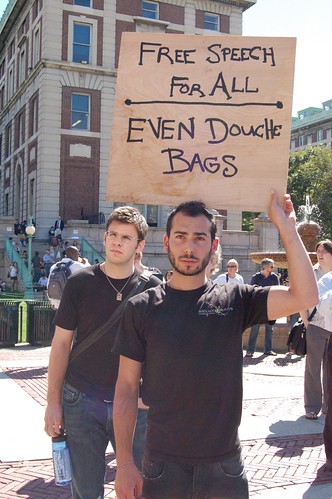
I love the First Amendment. In fact, I wish we could encourage people to go ahead and exercise their right to free speech a little more often. It's not clear to me why we don't let the teabaggers, birthers, and other wildeyed right wingers speak for themselves more often.
The blog's author, Andres Guadamuz, cites a quote he attributes to Douglas Adams:
“There’s a set of rules that anything that was in the world when you were born is normal and natural. Anything invented between when you were 15 and 35 is new and revolutionary and exciting, and you’ll probably get a career in it. Anything invented after you’re 35 is against the natural order of things.”
(If Adams is right, then I better speed up my tech-immersion: I turn 32 on Monday. Also, I'm officially putting all innovative technology designers on notice: Everything awesome must be designed and made public within the next three years.)
The Adams quote aligns with that old political axiom: If you're not liberal when you're young, you have no heart; if you're not conservative when you're old, you have no brains.
Both point to a key characteristic of most humans: the impulse toward self-preservation. For all their whinging about the dangers of participatory media, many if not most anti-tech curmudgeons will, when backed into a corner, acknowledge the democratic possibilities of new media, even if they're not sure those possibilities will ever be realized. As I explained in a recent post, I believe that people who engage in pro/con debates about social media become more strident in public than they are in private.
Guadamuz addresses a key issue of what he calls "the war between old media and the internet": the fact that when everyone is a potential media outlet, a lot of what gets published is drivel and dross. He writes:
We will always need some authoritative and well-written version of events, and for that the traditional publishing mechanisms will continue to exist. However, social media has come to allow more people’s voices to be made available. Is this a good thing? I personally think that it is a fundamental and empowering change in society, one that could potentially create a more participative and rich intellectual environment. Is there a lot of dross out there? Certainly! But there is also a lot of dross in traditional media, as any thinking person who picks up a copy of Heat magazine will attest to.
Guadamuz is right, of course. But, more importantly, the dross that exists on the internet has always existed; it's just that until the emergence of participatory media, the educated elites never had to lower themselves to engaging with it. Lame ideas, poorly designed creative works, ignorant or bigoted political stances, and individual identity work had no avenue for widespread expression, and so the people in charge got to act like none of the above actually existed. And, for all cultural intents and purposes, none of the above actually did exist.
Let me put a finer point on this: The decline-in-quality argument is an elitist stance in reaction to the transformative democratic potential of social media for the unwashed masses. I say this as an educated elite, as someone who has benefited as much as the next guy from the ability to participate in the dominant group's dominant Discourse.
People have always had stupid ideas and uninformed opinions; but what makes social media so powerfully transformative is that it allows people to not only communicate but also to refine, clarify, and potentially reject those ideas and opinions. Private opinions brought out in the sun are nearly always better than private opinions, privately held--especially when nearly everybody has approximately the same ability to express and circulate their beliefs.
This does not, by the way, make me an uncritical utopianist. I am aware that participatory media platforms allow stupid ideas to gain adherents and to therefore gain power. I'm also aware that these platforms make it so that more stupid ideas are more readily available, and that it becomes increasingly difficult--both individually and culturally--to separate the wheat from the chaff.
That's ok by me. Worrying about how to filter more opinions is way better than worrying about how to provide more people with platforms for expressing their opinions.*
*Note: We still need to worry about how to provide more people with platforms for expressing their opinions.
Most of the time, it really doesn't come up. Every once in a while, I get a lecherous/evil look when I hold my girlfriend's hand in public; every once in a while, when I'm deep in argument with a male friend or colleague, I or my ideas are brushed off with such a patronizing, cruelly dismissive tone that all bets are officially off. (I like to keep friends for as long as possible, but when I lose one, this is usually why.)
But most of the time, it doesn't come up. This is mostly because I'm wicked smart, hardworking, and ambitious--and I exhibit all of these traits in ways that enable me to play on the winning team.
By "the winning team," I mean members of what Jim Gee calls the "dominant Discourse." Gee differentiates "little 'd' discourses" from "big 'D' Discourses," which, he explains,
are ways of behaving, interacting, valuing, thinking, believing, speaking, and often reading and writing, that are accepted as instantiations of particular identities (or "types of people"_ by specific groups, whether families of a certain sort, lawyers of a certain sort, bikers of a certain sort, African-Americans of a certain soft, and so on and so forth through a very long list. Discourses are ways of being "people like us."
A dominant Discourse, for Gee, is the one that aligns most closely to a culture's dominant groups. In America, we might say broadly that the dominant group is white, middle- to upper-class straight men, and that they adhere with the least amount of trouble to our culture's dominant Discourse (because it aligns with the least amount of trouble with them). It's hard, but not impossible, for outsiders to learn (or fake) this Discourse, which is why it's mainly but not always rich white straight men at the top.
I may be gay, I may be female, and I may have blue-collar roots, but I learned the dominant Discourse early and well. It helps that I'm white, college-educated, and proficient in the finer details of language acquisition and communication. I may have to work extra hard to break into the first string, but I'm doing well enough to get to play--and being second or third string on the winning team is better than being even the star player on the team that (almost) always loses.
I spend so much time thinking and writing about how unfair it is that my team always wins that I forget sometimes that the dominant Discourse of which I am a part does not always work in my best interests either. It's why I've spent so much time worrying about whether my work at Project New Media Literacies exhibits a latent racism without giving a thought for how it may exclude the voices of non-mainstream women and queers. After all, the Teachers' Strategy Guide I've discussed here and heremay or may not fail in offering authentic avenues for the voices of ethnic minorities, but we should be just as concerned about how our work marginalizes the voices of women and, even more problematically, in this case, the voices of gay, lesbian, and transgendered scholars, writers, and artists.
I suppose I don't particularly enjoy thinking of myself as marginalized in any way. I suppose I don't particularly enjoy the thought that some of the actions that have led to my "success" have worked against my own best interests. I like the American narrative that we can all, every one of us, pull ourselves up by our own bootstraps--though interestingly, that idiom was originally intended to suggest an undertaking that's literally impossible to accomplish.
And part of me wants to step away from what's good for me and work toward what's good for all. Here, I rely on what Jim Gee identifies as two conceptual principles governing human discourse. (I'm citing the language from the second edition, instead of the more recent version, of Social Linguistics and Literacies, for reasons I'll identify below). Here are the principles:
First Principle That something would harm someone else (deprive them of what they or the society they are in view as 'goods') is always a good reason (though perhaps not a sufficient reason) not to do it.
Second Principle One always has the (ethical) obligation to (try to) explicate (render overt and primary) any theory that is (largely) tacit and either removed or deferred when there is reason to believe that the theory advantages oneself or one's group over other people or other groups.
Gee believes that these two principles are so fundamental to ethical discourse that all human beings would, assuming they understood them, accept them both. I agree, and I believe that my work, and the work of anybody working in any aspect of learning or education, is to use these principles to govern all discourse, all research, all engagement with learners and institutions. This is, to sum up an argument I've made more than once on this blog, the social justice work of the media literacy movement. Researchers engaging with elements of participatory culture are especially well-poised to break down and reshape the valued practices of new social spaces, to rework the hierarchy that keeps landing rich white straight men at the top.
Though Gee reworks the language, if not the basic sense, of these key principles in his most recent edition of Social Linguistics and Literacies, I greatly prefer the earlier edition. It's fiery, it's angry, and the chapter outlining these key principles ends with flagrant courage. After contending that any human being would have to accept the above principles as true, he writes that
failing to live up to them, they would, for consistency's sake, have to morally condemn their own behavior. However, I readily admit that, should you produce people who, understanding these principles, denied them, or acted as though they did, I would not give up the principles. Rather, I would withhold the term 'human,' in its honorific, not biological, sense, from such people.
In the third edition, Gee continues to assert that if someone refuses to accept these key principles, the argument "runs out," but he ends the section with this limp handshake:
An unexamined life isn't moral because it has the potential to hurt other people needlessly.
I kinda want the old Jim Gee back--the one who wasn't afraid to withhold the title of "human" from someone who refused to accept his ethical principles. Backing off from a fight, if that's what Gee's doing here, isn't doing anybody any favors.
All content on this blog has been relocated to my new website, making edible playdough is hegemonic. Please visit http://jennamcwilliams.com and update your bookmarks!







 Posts
Posts


