Showing posts with label teaching. Show all posts

Tuesday, June 8, 2010

how Jim Gee and I soothe our guilty consciences

In the video below of a presentation to the Education Writers Association 2010 Annual Conference, Jim Gee says this about how to introduce innovative ideas into education:
There's a choice of strategies here.... One strategy is: Let's take our innovations to the center of the school system and spread them as fast and quickly as we can. People believe that this current school system as it is will just co-opt those innovations and make them ... just better ways to do the old thing. Another strategy is: Let's make these innovative learning and assessment tools and put them at the margins, in places that will tolerate innovation, and then show it works. Now if you think about it, in technology outside of schools, going to the margins first and then to the center--that's always been the way innovation happens. The only place we've ever tried to keep putting the new thing right in the center at once is in schooling, and it's never worked. What i would love to see is that we hive of some of the (Race to the Top) money for a national center that would trial these new assessments, show they work in places that tolerate innovation, and then spread them there, just the way you would want if we have to keep coal and oil--let's at least have something trying out new forms of energy, so that we're ready for these markets but also we can prove they work. if we don't do that, we're just gonna get a better mousetrap.

I absolutely agree with the sentiments in the quote above, except for the BP oil spill. Let's say there's some innovative energy research going on in the margins, ready to prove it works and to take over where coal and oil left off. That's fantastic, and it doesn't do a single goddamned thing to help the birds, the fish, the sea mammals, the tourist industry, the ecosystem, the fisheries, and the human residents of the Gulf Coast. Those are simply casualties, not a single thing we can do to help them now no matter what awesome innovative fuel source we finally embrace, no matter how much more quickly we may embrace a cleaner fuel source as a result. Even if tomorrow's birds are safe from Big Oil, today's birds are drowning right in front of us.


Working at the margins of education is a fantastic way to innovate and offer useful evidence that innovations work. I fully support this approach--but not at the expense of the kids who exist at the center of our education system today. Yes, the school system can and does and maybe always will co-opt any innovation we try to introduce. But that doesn't excuse us from trying anyway. That doesn't give us license to give up on today's children, even if it keeps tomorrow's children safe.

And of course this isn't what Jim Gee wants to do, anyway. But the Jim Gees of the world who urge us to work at the margin live in symbiosis with the Jenna McWilliamses of the world who believe we must also work from the center, where--ironically--the most marginalized kids in education commonly reside. I can't innovate as much as I'd like from the center, maybe I can't help tomorrow's marginalized kids as much as I'd like either.  And Jim Gee can't help today's marginalized kids as much as he'd probably like from the edges. So we need each other, if for nothing else than to assuage our guilty consciences for being unable to do more of what we know must be done.

I should probably also note that Jim Gee is one of my absolute all-time heroes, so I hope he's not mad at me for this post.

This video also stars Daniel Schwartz, who I believe is one of the smartest guys thinking about assessment and learning these days. I had the great luck to attend an assessment working group with him and a big crew of assessment-focused researchers, and I was amazed and blown away by just about everything he said.

In a recent publication, Choice-Based Assessments in a Digital Age (.pdf), Schwartz and his co-author Dylan Arena make this argument:

Educational assessment is a normative endeavor: The ideal assessment both reflects and reinforces educational goals that society deems valuable. A fundamental goal of education is to prepare students to act independently in the world—which is to say, to make good choices. It follows that an ideal assessment would measure how well we are preparing students to do so.

I can't remember when I've agreed more emphatically with the introductory sentence of a scholarly article about education.

Here's the video, which is well worth a watch.

Saturday, May 15, 2010

principles for ethical educational research

I've been thinking lately about the burden of speaking for others.

Because I'm an educational researcher, and speaking for others is the heart of what we do. We walk into a classroom, watch some things happen for a little while, then make decisions about which stories are worth telling, and how, and why, and to whom. And this is precisely what we're supposed to do. This is precisely why we head into the classroom in the first place: to tell stories about what learning looks like.

But it can be such a heavy burden, this speaking for others. You know the burden is heavy when the simplest challenge is finding a way to represent what happened in a way that everybody would agree is reasonable and accurate. But that's not where our responsibility ends, because no research findings are politically or socially neutral. Every representation of research is an articulation of a belief system; it's an expression of a worldview; it's a document that leads people to act in ways that can help or hurt the populations we hope to represent.

And the burden gets heavier for researchers working with marginalized, oppressed, or disenfranchised populations, since speaking for these groups can so easily fall into a reproduction of the oppression that rains down on them from all around. Paulo Freire warns us against the "false charity" that so often comes from members of dominant groups who wish to help the oppressed:

False charity constrains the fearful and subdued, the "rejects of life," to extend their trembling hands. True generosity lies in striving so that these hands--whether of individuals or entire peoples--need to be extended less and less in supplication, so that more and more they become human hands which work and, working, transform the world.
It seems to me that false charity emerges when a person becomes too confident that she knows and understands the needs and interests of the oppressed groups she hopes to represent. False charity can therefore look like an awful lot of things: Research focusing on vocational education for poor kids. (Why would we dare to assume working class kids wouldn't want to go to college?) Research showing working class kids are capable of doing college-level work. (Using college readiness as our measure of 'success' allows policymakers to continue to make decisions that assume that college readiness is the most important goal, thereby continuing to marginalize kids for whom college is neither desired nor possible.) Research documenting the learning trajectories of immigrant students. (We're at a cultural point at which nearly anything that's said about immigrants, especially in America, can be twisted to hurt the very populations it's intended to help.)

I've been working in a small alternative high school populated primarily by lower class and working-class kids. I've seen miracles happen in this school for many of its students, and I've met graduates of the school who talk about their time in the school as the most powerful and important educational experience of their lives. Sitting in a classroom in this school, or walking down its halls, or talking to its students, reminds me of how powerfully transformative an education can be. I wish you could all spend a day at this school. You would walk out joyful, hopeful and optimistic about the future of our children. You would walk out with a renewed faith in human beings.

But you won't get the chance to visit this school, because the school board decided to shut it down. I probably don't need to tell you that I think this is a mistake. I further believe that the decision to close this school was motivated by a deep cultural prejudice against poor kids. We don't often say it out loud, but we hold a cultural belief that a child's value is largely determined by the likelihood that she will go to college; our culture is embarrassed by its children who are poor, who live in rented houses or youth shelters or foster care, who are not college-bound. Our society is built on the backs of these kids; we need their labor to keep our society running--and this need only embarrasses us all the more.

It's the job of researchers who work with marginalized populations to represent their research in a way that not only serves the best interests of those populations but also helps to rewrite the cultural narrative that keeps these populations oppressed. It's not easy work, simple work, or quick work, but it's necessary work.

With these things in mind, I want to offer a set of principles for educational research that I hope can help guide researchers in our work with marginalized populations--and maybe our work with all sorts of learning populations.

1. We exist in the service of the communities we work for. I have to believe that when we forget this, it's on accident. But we must never, ever forget that our work should first of all support the needs and interests of both the learners and the educators working inside of our chosen learning communities. This means that we have to actually talk to the learners and educators to find out what they want, and we have to take them at their word and not, for example, guess that if they knew more about the world they'd want something different.

2. We exist to serve the needs and interests of the communities we work for. It is not our job to decide whether a community's interests are good or right; it's only our job to work in service of those interests. If a researcher can't get behind the stated needs and interests of the members of her chosen research community, then she needs to find another community to research.

3. It's our job to represent our work in ways that support ethical decisions by policymakers and external stakeholders. Educational researchers serve as an important bridge between learning communities and policymakers who make decisions about the futures of those communities. One of our most essential roles is to represent research findings in a way that is clear and useful to policymakers while also representing to those policymakers findings that support the needs and interests of the communities we serve. I'm not saying this is easy. I'm just saying it's essential.

4. All educational research is social activism, and all educational researchers are social activists. There is no such thing as politically neutral educational research. Let me say that again: There is no such thing as politically neutral educational research. All statements of research findings are statements of a belief system about the role of education, and all researchers must therefore do research that both aligns with and serves to articulate that belief system. Further, all researchers must make their belief system clear, to themselves, to the communities they work for, and to policymakers who make decisions about those communities. They must always ensure that their belief system aligns with the needs and interests of the communities they work for, and if there is a conflict then the community's interests always trump the belief system of its researchers. If the ethical conflict is irreconcilable, then the researcher must find another community to represent.

Here I want to crib a quote from Jim Gee, who laid out his own set of principles for ethical human behavior in his book Social Linguistics and Literacies. After describing these principles, he made this declaration:

I would claim that all human beings would, provided they understood them, accept these conceptual principles. Thus, failing to live up to them, they would, for consistency’s sake, have to morally condemn their own behavior. However, I readily admit that, should you produce people who, understanding these principles, denied them, or acted as though they did, I would not give up the principles. Rather, I would withhold the term ‘human’, in its honorific, not biological, sense, from such people.

This declaration was made in the second edition of Gee's book; if you own the third edition, don't bother looking for the quote--for reasons that are unclear to me, he removed it and instead simply asserts that we really shouldn't bother trying to change the minds of people who disagree with these ethical principles. I want to call for a return to the stronger language. Given the incredibly high stakes of public education in America, we don't have time for politeness. We're in a fight for the very lives of the students we serve, and it may be that too much politeness is what got us here in the first place.

Thursday, May 6, 2010

notes on being the chainsaw you wish to see in the world: Closing remarks for the AERA 2010 annual meeting

I just got back from my first trip to the annual meeting of AERA, the American Educational Research Association. AERA is apparently the biggest educational research conference in America. I had a fantastic time (highlight: I got to have dinner with Jim Gee!) and my presentation went well (highlight: I argued with the panel's discussant over why thinking about gender inequity isn't enough if you're not also thinking about class inequity!), and I don't think I made too much of a fool out of myself.

I really enjoyed my first trip to this conference, though when I got home I learned from others that there are significant challenges to be made about the structure, format, and ethos of AERA. I am coming around to that way of thinking and will post my thoughts on this soon.

For now, though, I want to share with you the paper I had to writereallyfast when I got back from the conference. It's a final paper for a course on computational technologies, and because I was thinking about AERA, social justice, and why the conference's biggest events mostly featured staid, mainstream thinkers, I decided to write the paper as closing remarks for the conference. I am sure that once the AERA organizers read my closing remarks, they will invite me to deliver next year's closing remarks in person. I am also available to deliver opening remarks and keynote addresses.


Notes on being the chainsaw you wish to see in the world: On a critical computational literacy agenda for a time of great urgency
Closing Remarks for the AERA Annual Meeting
Jenna McWilliams, Indiana University
May 4, 2010


I want to thank you for giving me the opportunity to speak this evening, at the close of this year’s annual meeting of the American Educational Research Association.

I want to talk to you tonight about the nature of urgency.

Because urgency characterizes the work we do, doesn’t it? The education of our children—our efforts to prepare them to join in on this beautiful and necessary project of naming and claiming the world—it is certainly a matter of the deepest urgency. Even more so because of the war being waged over the bodies and minds of our children.

It’s a war whose contours are deeply familiar to many of us—more so the longer we have been a part of this struggle over education. Certainly the issues we’re fighting over have limned the edges of our educational imagination for generations: How do we know what kids know? How can we prepare them for success in their academic, vocational, and life pursuits? What should schools look like, and how can we fill our schools up with qualified teachers who can do their jobs well? No matter what else, then, at least we’re continuing to ask at least some of the right questions.

Yet a deeper than normal sense of urgency has characterized this year’s annual meeting. It was a “hark ye yet again” sort of urgency: We stood, once again, on a knife’s edge, waiting for word of legislative decisions to be passed down from the policymakers—among whom there are very few educational researchers—to the researchers—among whom there are very few policymakers.

And what sorts of decisions were we waiting to hear on? The same sorts we’ve been wringing our hands over for a decade or more: Decisions over the standardization of education. Development of a proposed set of Common Core Standards whose content seemed painfully anemic to many of us. We’re waiting to learn whether teacher pay will be linked to student performance on standardized tests. Massive budget cuts leading to termination of teachers and programs—these certainly feel familiar to us, though the scope of these cuts and the potential consequences of these decisions seem to loom larger than ever before. The decision by the Texas Department of Education to pervert and politicize its K-12 curriculum by removing references to historical events and even terminology that might offend members of the political Right-—the specifics are new, but the story feels familiar.

A call to action was paired with the clanging of the alarm bells. Ernest Morrell told us that he had counseled his kids to prepare presentations that not only described their work and achievements but that also included a call to action. “I told them, ’Don’t let them leave this room without marching orders’,” he said. “We need to do better. AERA needs to do better.”

He’s right, of course. And I plan to heed Ernest’s advice and not let you leave this room without your marching orders. But first I want to explore the edges of this new urgency, explain why critical computational literacy is part and parcel of the urgency of this moment, and explain exactly what I mean by the term.

There are at least two reasons for the acuteness of the urgency that has characterized this year’s AERA conference. The first is that many of us had hoped for something more, something better, something more honorable from the Obama administration. After eight years living in a political wasteland, many of us felt a glee all out of proportion with reality upon hearing Barack Obama’s position on educational issues. We felt hope. Even a warm half cup of water can feel like a long, tall drink when you’ve just walked out of a desert.

It’s a long revolution, you know. And if Obama authorizes something that looks very much like No Child Left Behind, and if he mandates merit pay based on student performance on standardized tests, and if the recent changes made by the religious right to the Texas state history curriculum stand, and if school board nationwide continue to make terrible, terrible decisions about how to cut costs, and if we see the largest teacher layoff in our history and class sizes creep up to 40 students per room and if computers get taken over by test prep programs and remedial tutoring systems, well, we’ll do our best to live to fight another day. The other day, I listened to Jim Gee talking about his deep anger at the people who run our education system. But he also said something we should all take to heart: “I’ll fight them until I’m dead,” he said. Let’s embrace this position. If they want to claim the hearts and minds of our children, let’s make it so they do it over our cold, dead bodies.

Let’s not let ourselves begin to believe that the stakes are any lower than they actually are. This is the second reason for the urgency this year: There is the very real prospect that the decisions we make within our educational system will get taken up by education departments across the globe. Around 30 of us attended an early-morning session called “Perspectives From the Margins: Globalization, Decolonization, and Liberation.” The discussants, Michael Apple and Dave Stovall, spoke with great eloquence about the nature of this urgency. You’ll forgive me for secretly recording and then transcribing a piece of each of their talks here.

Michael Apple, responding to a powerful presentation on rural science education by researcher Jeong-Hee Kim and teacher-researcher Deb Abernathy, spoke of the far-reaching implications of the local decisions we make:
As we sit here, I have people visiting me from China. They are here to study No Child Left Behind, and they are here to study performance pay. All of the decisions we make that that principal and Deb and you are struggling against are not just struggles in the United States, they are truly global—so that the decisions we make impact not just the kids in the rural areas of the United State, but the rural areas of the people who are invisible, the same people who deconstruct our computers.

Dave Stovall, from the University of Illinois in Chicago, underscored the need to think of the global implications of the policy decisions that intersect within the realm of education:

Arizona is Texas is Greece is Palestine is where we are. This day and time is serious. When a person in Texas cannot say the world capitalism in a public school, we live in serious times. When a person in Arizona can be taken out of a classroom at five years old, to never return, we live in serious times. When we can rationalize in the state of Illinois and city of Chicago that having 5 grams of heroin on a person accounts for attempted murder, we’re living in different times. When we can talk about in Palestine that young folks have now been deemed the most violent threat to the Israeli state, we’re living in different times. And now, how do we engage and interrupt those narratives based again on the work we do?

These times are different and serious, and talking about critical computational literacy may make me look a little like Nero with his fiddle. But critical computational literacy, or indeed its paucity in our education system, is the dry kindling that keeps Rome burning.

I’ll explain why. Let’s talk for a minute about another Apple, the electronics company Apple Corp. The year 2010 marked the release of Apple’s iPad, a tablet computer designed as a multipurpose information and communication tool. Despite mixed reviews of its usability and features, records show an estimated 500,000 units sold between pre-orders and purchases in the first week after the iPad’s release.

This has been accompanied by a push for consideration of the iPad’s utility for education, especially higher education, with schools working to develop technical support for iPad use on campus and at least one university, Seton Hall, promising to provide all incoming freshmen with iPads along with Macbooks. One question—-how might the iPad transform education?-—has been the topic of conversation for months.

“The iPad,” crowed Neil Offen in the Herald-Sune (2010), “could be more than just another way to check your e-mail or play video games. It has the potential to change the way teachers teach and students learn.”

Certainly, these conversations reflect a positive shift in attitudes about what comprises literacy in the 21st Century. If you attended the fantastic symposium on Sunday called “Leveraging What We Know: A Literacy Agenda for the 21st Century,” you heard from the panelists a powerfully persuasive argument that “literacy” is no longer simple facility with print media. Indeed, facility with print media may still be necessary, but it’s no longer sufficient. As the emergence of the iPad, the Kindle, and similar literacy tools make evident, the notion of “text” has become more aligned with Jay Lemke’s (2006) description of “multimedia constellations”—loose groupings of hypermediated, multimodal texts that exist “not just in the imagination of literary theorists, but in simple everyday fact” (pg. 4). Add to this the ongoing contestation of the tools we use to access and navigate those constellations of social information, and the urgency of a need to shift how we approach literacy becomes increasingly obvious.

As anyone who works in the literacy classroom knows, this is by no means a simple task. This task is complicated even further by the dark side of this new rhetoric about literacy: There’s a technological determinism hiding in there, an attitude that suggests an educational edition of Brave New Worldism. Offen’s celebration of the iPad aligns with the approach of Jeremy Roschelle and his colleagues (2000), who a decade ago trumpeted the transformative potential of a range of new technologies. In explaining that “certain computer-based applications can enhance learning for students at various achievement levels,” they offer descriptions of promising applications for improving how and what children learn. The ‘how’ and the ‘what’ are separated because not only can technology help children learn things better, it also can help them learn better things” (pg. 78, emphasis mine).

More recently, the media scholar Henry Jenkins (2006) described the increasingly multimodal nature of narratives and texts as “convergence culture.” As corporate and private interests, beliefs, and values increasingly interact through cheaper, more powerful and more ubiquitous new technologies, Jenkins argues, our culture is increasingly defined by the collision of media platforms, political ideologies, and personal affinities. Jenkins celebrates the emergence of this media convergence, arguing that “(i)n the world of media convergence, every important story gets told, every brand gets sold, and every consumer gets courted across multiple media platforms” (pg. 3).

Brave new world, indeed. But there is reason to wear a raincoat to this pool party, as a cursory examination of the developing “Apple culture” of electronics confirms. The iPad, celebrated as a revolution in personal computing, communication, and productivity—and marketed as an essential educational tool—is a tool with an agenda. The agenda is evident in Apple’s decision to block the educational visual programming software Scratch: Though Apple executives have claimed that applications like Scratch may cause the iPad to crash, others argue that the true motivation behind this decision is to block a tool that supports media production. The Scratch application allows users to build new applications for the iPad, which Bruckman (2010) suggests goes far beyond Apple’s unstated interest in designing its products primarily for media consumption.

There is no closest competitor to the iPad, so users who want to leverage the convenience, coolness, and computing power of this product must resign themselves to the tool Apple provides. Similarly, as Apple develops its growing monopoly in entertainment (iPods), communications (iPhone), and portable computing (Macbook), Apple increasingly has the power to decide what stories to tell, and why, and how.

Now let’s go back to the other Apple, Michael Apple, who argues quite convincingly about the colonization of the space of the media by the political right wing (2006). We have, he argues, politicians deciding what we pay attention to, and we have corporations deciding how we pay attention to it. This makes the need for critical computational literacy even more important than ever before. Perhaps it’s more important than anything else, though I’ll leave that to the historians to decide.

What is this thing I’m calling “critical computational literacy”? Since I’m almost the only person using this term, I want to start by defining it. It has its roots in computational literacy, which in itself bears defining. Andy diSessa (2001) cautions us against confusing computational literacy with “computer literacy,” which he describes as being able to do things like turning on your computer and operating many of its programs. His definition of computational literacy, he explains, makes computer literacy look “microscopic” in comparison (p. 5). For him, computational literacy is a “material intelligence” that is “achieved cooperatively with external materials” (p. 6).

This is a good start in defining computational literacy but probably still not enough. And please do remember that I will not let you leave this room without marching orders; and if I want you to know what to do, I have to finish up the definition. Let’s add to diSessa’s definition a bit of the abstraction angle given to us by Jeanette Wing (2008), who shifts the focus slightly to what she labels “computational thinking.” She describes this as
a kind of analytical thinking. It shares with mathematical thinking in the general ways in which we might approach solving a problem. It shares with engineering thinking in the general ways in which we might approach designing and evaluating a large, complex system that operates within the constraints of the real world. It shares with scientific thinking in the general ways in which we might approach understanding computability, intelligence, the mind and human behaviour. (pg. 3716)

For Wing, the essential component of computational thinking is working with abstraction, and she argues that an education in computational thinking integrates the “mental tool” (capacity for working with multiple layers of abstraction) with the “metal tool” (the technologies that support engagement with complex, abstract systems).

So. We have diSessa’s “material intelligence” paired with Wing’s “computational thinking”—a fair enough definition for my purposes. But what does it look like? That is, how do we know computational literacy when we see it?

The answer is: it depends. Though we have some nice examples that can help make visible what this version of computational literacy might look like. Kylie Peppler and Yasmin Kafai (2007), who by the way have a new book out on their work with the Computer Clubhouse project (you can buy a copy up at the book fair), offer instructive examples of children working with Scratch. Jorge and Kaylee, their two case studies, are learners who make creative use of a range of tools to build projects that extend, as far as their energy and time will allow, the boundaries of what is possible to make through a simple visual programming language. Bruce Sherin, Andy diSessa, and David Hammer (1993) give an example of their work with Dynaturtle to advance a theory of “design as a learning activity”; in their example, learners work with the Boxer programming language to concretize abstract thought.

Certainly, these are excellent examples of computational literacy in action. But I would like to humbly suggest that we broaden our understanding of this term far beyond the edges of programming. Computational literacy might also be a form of textual or visual literacy, as learners develop facility with basic html code and web design. It might be the ability to tinker—to actually, physically tinker, with the hardware of their electronics equipment. This is something that’s typically frowned upon, you know. Open up your Macbook or your iPhone and your warranty is automatically null and void. This is not an accident; this is part of the black box approach of electronics design that I described earlier.

Which leads me to the “critical” component of computational literacy. This is no time for mindless tinkering; we are faced with a war whose terms have been defined for us by members of the political Right, and whose battles take place through tools and technologies whose uses have been defined for us by corporate interests. Resistance is essential. In the past, those who resisted the agendas of software designers and developers were considered geeks and freaks; they were labeled “hackers” and relegated to the cultural fringes (Kelty 2008). Since then, we have seen an explosion in access to and affordability of new technologies, and the migration to digitally mediated communication is near-absolute. The penetration of these technologies among young people is most striking: (include statistics). Suddenly, the principles that make up the “hacker ethos” (Levy, 1984) take on new significance for all. Suddenly, principles that drove a small subset of our culture seem more like universal principles that might guide cultural takeup of new technologies:

  • Access to computers—and anything which might teach you something about the way the world works—should be unlimited and total.
  • All information should be free.
  • Mistrust authority—promote decentralization.
  • Hackers should be judged by their hacking, not criteria such as degrees, age, race, sex, or position.
  • You can create art and beauty on a computer.
  • Computers can change your life for the better. (Levy 1984)


If these principles seem overtly ideological, overtly libertarian, that’s because they are. And I’m aware that in embracing these principles I run the risk of alienating a fairly significant swath of my audience. But there’s no time for gentleness. This is no time to hedge. I believe, as Michael Apple and Dave Stovall and Rich Ayers and others have argued persuasively and enthusiastically, that we are fighting to retrieve the rhetoric of education from the very brink. It’s impossible to fight a political agenda with an apolitical approach. We must fight now for our very future.

That’s the why. Now I’d like to tackle the how. If we want our kids to emerge from their schooling experience with the mindset of critical computational literacy, we need to first focus on supporting development of critical computational literacy in our teachers. They, too, are subject to all of the pressures I listed earlier, and add to the mix at least one more: They are subject to the kind of rhetoric that Larry Cuban (1986) reminds us has characterized talk of bringing new technologies into the classroom since at least the middle of the 20th century. As he researched the role of technologies like radio, film, and television in schools, he described the challenges of even parsing textual evidence of technologies’ role:

Television was hurled at teachers. The technology and its initial applications to the classroom were conceived, planned, and adopted by nonteachers, just as radio and film had captured the imaginations of an earlier generation of reformers interested in improving instructional productivity…. Reformers had an itch and they got teachers to scratch it for them. (p. 36)

This certainly hearkens, does it not, of the exhortation of Jeremy Roschelle and his colleagues? I repeat:
promising applications for improving how and what children learn. The ‘how’ and the ‘what’ are separated because not only can technology help children learn things better, it also can help them learn better things.

Teachers are also faced with administrators who say things like these quotes, taken from various online conversations about the possible role of the iPad in education.

I absolutely feel the iPad will revolutionize education. I am speaking as an educator here. All it needs are a few good apps to accomplish this feat.

Tablets will change education this year and in the future because they align neatly with the goals and purposes of education in a digital age.

And finally, the incredibly problematic:
As an educational administrator for the last eleven years, and principal of an elementary school for the past seven…after spending three clock hours on the iPad, it is clearly a game changer for education.

Three hours. Three hours, and this administrator is certain that this, more than any previous technology, will transform learning as we know it. Pity the teachers working at his school, and let’s hope that when the iPad gets hurled at them they know how to duck.

We must prepare teachers to resist. We must prepare them to make smart, sound decisions about how to use technologies in the classroom and stand tall in the face of outside pressures not only from political and corporate interests but from well-meaning administrators and policymakers as well. There is a growing body of evidence that familiarity with new tools is—just like print literacy—necessary but not sufficient for teachers in this respect.

There is evidence, however, that experience with new technologies when paired with work in pedagogical applications of those technologies can lead to better decision-making in the classroom. I recommend the following three-part battle plan:

First, we need to start building a background course in new media theory and computational thinking into our teacher education programs. My home institution, Indiana University, requires exactly one technology course, and you can see from the description that it does its best to train pre-service teachers in the use of PowerPoint in the classroom:
W 200 Using Computers in Education (1-3 cr.)Develops proficiency in computer applications and classroom software; teaches principles and specific ideas about appropriate, responsible, and ethical use to make teaching and learning more effective; promotes critical abilities, skills, and self-confidence for ongoing professional development.
Fortunately, we can easily swap this course out for one that focuses on critical computational literacy, since the course as designed has little practical use for new teachers.

Second, we need to construct pedagogy workshops that stretch from pre-service to early in-service teachers. These would be designed to support lesson development within a specific domain, so that all English teachers would work together, all Math teachers, all Science teachers, and so on. This could stretch into the early years of a teacher’s service and support the development of a robust working theory of learning and instruction.

Finally, we might consider instituting ongoing collaborative lesson study so that newer teachers can collaborate with veteran teachers across disciplines. I offer this suggestion based on my experience working in exactly this environment over the last year. In this project, teachers meet monthly to discuss their curricula and to share ideas and plan for future collaborative projects. They find it intensely powerful and incredibly useful as they work to integrate computational technologies into their classrooms.

I’m near the end of my talk and would like to finish with a final set of marching orders. If we want to see true transformation, we need first to tend our own gardens. Too often—far, far too far too often—we educational researchers treat teachers as incidental to our interventions. At the risk of seeming like an Apple fanboy, I return once again to the words of Michael Apple, who argued brilliantly this week that it’s time to rethink how we position teachers in our work. We say we want theory to filter down to the “level” of practice; the language of levels, Apple says, is both disingenuous and dangerous. Let’s tip that ladder sideways, he urges us, and he is absolutely correct. We live and work in the service of students first, and teachers second. We should not forget this. We should take care to speak accordingly.

These are your marching orders: To bring the message of critical computational literacy and collaboration during this time of great urgency back to your home institutions, to the sites where you work, to the place where you work shoulder to shoulder with other researchers, practitioners, and students. I urge you to stand and to speak, loudly, and with as much eloquence as you can muster, about the issues of greatest urgency to you. This is no time to speak softly. This is no time to avoid offense. In times of great urgency, it’s not enough to be the change we wish to see in the world; we need to be the chainsaws that we wish to see in the world. That is what I hope you will do when you leave this convention center. Thank you.


References

Apple, M.W. (2006). Educating the “right” way: Markets, standards, God, and inequality. New York: Routledge.
Bruckman, A (2010, April 15). iPhone application censorship (blog post). The next bison: Social computing and culture. Retrieved at http://nextbison.wordpress.com/2010/04/15/iphone-application-censorship/.
Carnoy, M. (2008, August 1). McCain and Obama’s educational policies: Nine things you need to know. The Huffington Post. Retrieved at http://www.huffingtonpost.com/martin-carnoy/mccain-and-obamas-educati_b_116246.html.
Carter, D. (2010, April 5). Developers seek to link iPad with education. eSchool News. Retrieved from http://www.eschoolnews.com/2010/04/05/ipad-app-store-has-wide-selection-of-education-options/.
Cuban, L. (1986). Teachers and machines. New York: Teachers College Press.
diSessa, A. A. (2000). Changing minds : Computers, learning, and literacy. Cambridge, Mass.: MIT Press.
Jenkins, H. (2006). Convergence culture: Where old and new media collide. Cambridge, MA: MIT Press.
Kelty, C. (2008). Two bits: The cultural significance of free software. Durham, NC: Duke University Press.
Kolakowski, N. (2010). Apple iPad, iPhone Expected to Boost Quarterly Numbers. eWeek, April 18, 2010. Retrieved at http://www.eweek.com/c/a/Desktops-and-Notebooks/Apple-iPad-iPhone-Expected-to-Boost-Quarterly-Numbers-825932/.
Korn, M. (2010). iPad Struggles at Some Colleges. Wall Street Journal, April 19, 2010. Retrieved at http://online.wsj.com/article/SB10001424052748703594404575192330930646778.html?mod=WSJ_Tech_LEFTTopNews.
Lemke, J. (2006). Toward Critical Multimedia Literacy: Technology, research, and politics. In M.C. McKenna et al. (Eds.), International handbook of literacy and technology: Volume II. Mahwah, NJ: Lawrence Erlbaum Associates Inc. (3-14).
Levy, S 1984. Hackers: Heroes of the computer revolution. New York: Anchor Press/Doubleday.
McCrae, B. (2010, Jan. 27). Measuring the iPad’s potential for education. T|H|E Journal. Retrieved from http://thejournal.com/articles/2010/01/27/measuring-the-ipads-potential-for-education.aspx.
New York Times (2010, March 17). Editorial: Mr. Obama and No Child Left Behind. New York Times Editorial Page. Retrieved from http://www.nytimes.com/2010/03/18/opinion/18thu1.html.
Offen, N. (2010, Jan. 28). The iPad and education. The Herald-Sun. Retrieved from http://www.heraldsun.com/view/full_story/5680899/article-The-iPad---education?instance=main_article.
PBS (2010, Jan. 7). How will the iPad change education? PBS TeacherLine Blog. Retrieved from http://www.pbs.org/teacherline/blog/2010/01/how-will-the-ipad-change-education/.
Peppler, K. A., & Kafai, Y. B. (2007). From SuperGoo to Scratch: exploring creative digital media production in informal learning. Learning, Media and Technology, 32(2), 149-166.
Roschelle, J. M., Pea, R. D., Hoadley, C. M., Gordin, D. N., & Means, B. M. (2000). Changing how and what children learn in school with computer-based technologies. The future of children, 10(2), 76–101.
Sherin, B., DiSessa, A. A., & Hammer, D. M. (1993). Dynaturtle revisited: Learning physics through collaborative design of a computer model. Interactive Learning Environments, 3(2), 91-118.
Smith, E. (2010, April 16). The Texas Curriculum Massacre. Newsweek. Retrieved at http://www.newsweek.com/id/236585.
Wing, J. M. (2008). Computational thinking and thinking about computing. Philosophical Transactions A, 366(1881), 3717-3717.

**Update, 5/6/10, 1:09 p.m.: I have changed this post slightly to remove an unfair attack against a presenter at this year's AERA Annual Meeting. He points out in the comments section below that my attack was unfair, and I agree and have adjusted the post accordingly.

Thursday, April 15, 2010

short-sighted and socially destructive: Ning to cut free services

Lord knows I'm not a huge fan of Ning, the social networking tool that allows users to create and manage online networks. I find the design bulky and fairly counterintuitive, and modifying a network to meet your group's needs is extremely challenging, and Ning has made it extremely difficult or impossible for users to control, modify, or move network content. Despite the popularity of Ning's free, ad-supported social networks among K-16 educators, the ads that go along with the free service have tended toward the racy or age-inappropriate.

But given the Ning trifecta--it's free, getting students signed up is fast and fairly easy, and lots of teachers are using it--I've been working with Ning with researchers and teachers for the last two years. So the recent news that Ning will be switching to paid-only membership is obnoxious for two reasons.

The first reason is the obvious: I don't want to pay--and I don't want the teachers who use Ning to have to pay, either. One of the neat things about Ning is the ability to build multiple social networks--maybe a separate one for each class, or a new one each semester, or even multiple networks for a single group of students. In the future, each network will require a monthly payment, which means that most teachers who do decide to pay will stick to a much smaller number of networks. This means they'll probably erase content and delete members, starting fresh each time. The enormous professional development potential of having persistent networks filled with content, conversations, and student work suddenly disappears.

Which brings me to my second point: That anyone who's currently using Ning's free services will be forced to either pay for an upgrade or move all of their material off of Ning. This is tough for teachers who have layers upon layers of material posted on various Ning sites, and it's incredibly problematic for any researcher who's working with Ning's free resources. If we decide to leave Ning for another free network, we'll have to figure out some systematic way of capturing every single thing that currently lives on Ning, lest it disappear forever.

Ning's decision to phase out free services amounts to a paywall, pure and simple. Instead of putting limits on information, as paywalls for news services do, this paywall puts limits on participation. In many ways, this is potentially far worse, far more disruptive and destructive, far more short-sighted than any information paywall could be.

If Ning was smart, it would think a little more creatively about payment structures. What about offering unlimited access to all members of a school district, for a set fee paid at the district level? What about offering an educator account that provides unlimited network creation for a set (and much lower) fee? What about improving the services Ning provides to make it feel like you'd be getting what you paid for?

More information on Ning's decision to go paid-only will be released tomorrow. For now, I'm working up a list of free social networking tools for use by educators. If you have any suggestions, I'd love to hear them.

Update, 4/15/10, 6:48 p.m.: Never one to sit on the sidelines in the first place, Alec Couros has spearheaded a gigantic, collaborative googledoc called "Alternatives to Ning." As of this update, the doc keeps crashing because of the number of collaborators trying to help build this thing (the last time I got into it, I was one of 303 collaborators), so if it doesn't load right away, keep trying.

Tuesday, April 6, 2010

why I am not a constructionist

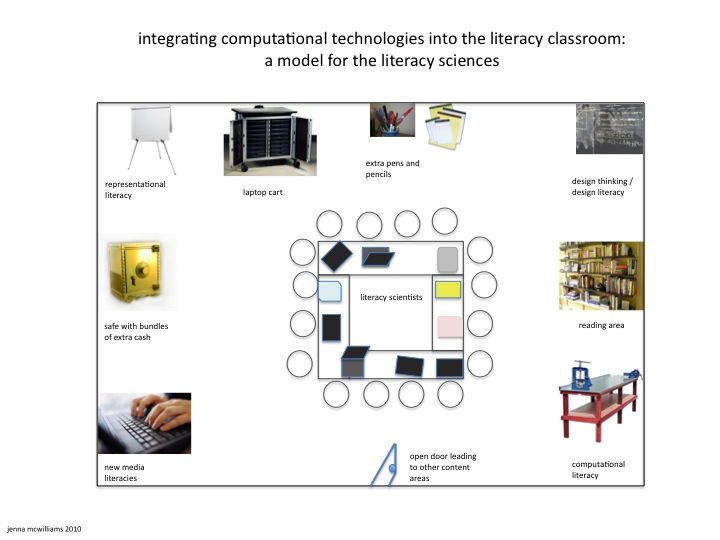
and why you should expect more from my model for integrating technologies into the classroom

I recently showed some colleagues my developing model for integrating computational technologies into the classroom. "This is," one person said, "a really nice constructionist model for classroom instruction."

Which is great, except that I'm not a constructionist.

Now, don't be offended. I'll tell you what I told my colleague when she asked, appalled, "What's wrong with constructionists?"

Nothing's wrong with constructionists. I just don't happen to be one.

a brief history lesson
Let's start with some history. Constructionism came into being because two of the greatest minds we've had so far converged when Jean Piaget, known far and wee as the father of constructivism, invited Seymour Papert to come work in his lab. Papert later took a faculty position at MIT, where he developed the Logo programming language, wrote Mindstorms, one of his canonical books, and laid the groundwork for the development of constructionism.

Here's a key distinction to memorize: While constructivism is a theory of learning, constructionism is both a learning theory and an approach to instruction. Here's how the kickass constructionist researcher Yasmin Kafai describes the relationship between these terms:

Constructionism is not constructivism, as Piaget never intended his theory of knowledge development to be a theory of learning and teaching.... Constructionism always has acknowledged its allegiance to Piagetian theory but it is not identical to it. Where constructivism places a primacy on the development of individual and isolated knowledge structures, constructionism focuses on the connected nature of knowledge with its personal and social dimensions.

Papert himself said this:
Constructionism--the N Word as opposed to the V word--shares constructivism's connotation to learning as building knowledge structures irrespective of the circumstances of learning. It then adds the idea that this happens especially felicitously in a context where the learner is consciously engaged in constructing a public entity whether it's a sand castle on the beach or a theory of the universe.

Examples of constructionist learning environments include the well known and widespread Computer Clubhouse program, One Laptop Per Child, and learning environments built around visual programming tools like Scratch and NetLogo.

why I am not a constructionist
Constructionism is really neat, and some of the academics I respect most--Kafai, Kylie Peppler, Mitch Resnick, Idit Harel, for example--conduct their work from a constructionist perspective. A couple of things I like about the constructionist approach is its emphasis on "objects to think with" and some theorists' work differentiating between wonderful ideas and powerful ideas.

Constructionist instruction is a highly effective approach for lots of kids, most notably for kids who haven't experienced success in traditional classroom settings. But as Melissa Gresalfi has said more than once, people gravitate to various learning theories when they decide that other theories can't explain what they're seeing. Constructionism focuses on how a learning community can support individual learners' development, which places the community secondary to the individual. I tend to wonder more about how contexts support knowledge production and how contexts lead to judgments about what counts as knowledge and success. If it's true, for example, that marginalized kids are more likely to find success with tools like Scratch, then what matters to me is not what Scratch offers those kids that traditional schooling doesn't, but what types of knowledge production the constructionist context offers that aren't offered by the other learning contexts that fill up those kids' days. I don't care so much about what kids know about programming; I'm far more interested in the sorts of participation structures made possible by Scratch and other constructionist tools.

If you were wondering, I'm into situativity theory and its creepy younger cousin, Actor-Network Theory. So what I'm thinking about now is what sorts of participation structures might be developed around a context that looks very much like the diagram below. Specifically, I'm wondering: What sorts of participation structures can support increasingly knowledgeable participation in a range of contexts that integrate computation as a key area of expertise?


why I'm mentioning this now
My thinking about this is informed of late by what I consider to be some highly problematic thinking about equity issues in technology in education. A 2001 literature review by Volman & vanEck focuses on how we might just rearrange the classroom some to make girls feel more comfortable with computers. For example, they write that

to date, research has not produced unequivocal recommendations for classroom practice. Some researchers found that girls do better in small groups of girls; some researchers argue in favor of such groups on theoretical grounds (Siann & MacLeod, 1986, Scotland; Kirkup, 1992, United Kingdom). Others show that girls perform better in mixed groups (Kutnick, 1997, United Kingdom) or that girls benefit more than boys do from working together (Littleton et al., 1992, United Kingdom). Other student characteristics such as competence and experience in performing the task seem in any case to be equally important, both in primary and secondary education. An explanation for girls’ achieving better results in mixed pairs is that they have more opportunity to spend time with the often-more-experienced boys. The question, however, is whether this solution has negative side effects. It may all too easily confirm the image that girls are less competent when it comes to computers. Another solution may be that working in segregated groups compensates for the differences in experience. Tolmie and Howe (1993, Scotland, secondary education) argue strongly for working in small mixed groups because of the differences they identified between the approaches taken by groups of girls and groups of boys in solving a problems.

For the love of pete, the issue is not whether girls feel more comfortable working in small groups or mixed groups or pairs or individually; the issue is why in the hell we have learning environments that allow for these permutations to matter to girls' access to learning with technologies.

Also, just for the record, the gender-equity issue in video gaming cannot be resolved just by building "girl versions" of video games, no matter what Volman and vanEck believe. They write:

Littleton, Light, Joiner, Messer, and Barnes (1992, United Kingdom, primary education) found that gender differences in performance in a computer game disappeared when the masculine stereotyping in that game was reduced. In a follow-up study they investigated the performance of girls and boys in two variations of an adventure game (Joiner, Messer, Littleton, & Light, 1996). Two versions of the game were developed, a “male” version with pirates and a “female” version with princesses. The structure of both versions of the game was identical. Girls scored lower than boys in both versions of the game, even when computer experience was taken into account; but girls scored higher in the version they preferred, usually that with the princesses.

I don't think that the researchers cited by Volman and vanEck intended their work to be interpreted this way, but this is exactly the trouble you get into when you start talking about computational technologies in education: People think the tool, or the slight modification of it, is the breakthrough, when the breakthrough is in how we shift instructional approaches through integration of the tool--along with a set of technical skills and practices--for classroom instruction.

Looking at my developing model, I can see that I'm in danger of leading people to the same interpretation: Just put this stuff in your classroom and everything else will work itself out. This is what happens when you frontload the tool when you really mean to frontload the practices surrounding that tool that matter to you.

This is the next step in the process for me: Thinking about which practices I hope to foster and support through my classroom model and deploying various technologies for that purpose. I'll keep you posted on what develops.

One last note
I've included here a discussion about why I'm not a constructionist along with a discussion of gender equity issues in education, but I don't at all want anybody to take this as a critique of constructionism. I declare again: Nothing's wrong with constructionism. I just don't happen to be a constructionist. Also, I think a lot of really good constructionist researchers have done some really, really good work on gender equity issues in computing, and I'm just thrilled up the wazoo about that and hope they can find ways to convince people to stop misinterpreting constructionism in problematic ways.

References, in case you're a nerd
Joiner, R., Messer, D., Littleton, K., & Light, P. (1996). Gender, computer experience and computer-based problem solving. Computers and Education, 26(1/2), 179–187.
Kafai, Y. B. (2006). Constructivism. In K. Sawyer (Ed.), Handbook of the Learning Sciences (pp. 35-46). Cambridge, MA: Cambridge University Press.
Kirkup, G. (1992). The social construction of computers. In G. Kirkup and L. Keller (Eds.), Inventing women: Science, gender and technology (pp. 267–281). Oxford: Polity Press.
Kutnick, P. (1997). Computer-based problem-solving: The effects of group composition and social skills on a cognitive, joint action task. Educational Research, 39(2), 135–147.
Littleton, K., Light, P., Joiner, R., Messer, D., & Barnes, P. (1992). Pairing and gender effects in computer based learning. European Journal of Psychology of Education, 7(4), 1–14.
Papert, S., & Harel, I. (1991). Situating Constructionism. In Papert & Harel, Constructionism. Ablex Publishing Corporation. Available online at http://www.papert.org/articles/SituatingConstructionism.html.
Siann, G., & MacLeod, H. (1986). Computers and children of primary school age: Issues and questions. British Journal of Educational Technology, 2, 133–144.
Tolmie, A., & Howe, C. (1993). Gender and dialogue in secondary school physics. Gender and Education, 5(2), 191–210
Volman, M., & van Eck, E. (2001). Gender Equity and Information Technology in Education: The Second Decade. [10.3102/00346543071004613]. Review of Educational Research, 71(4), 613-634.


my model, in case you were wondering

Tuesday, March 2, 2010

notes from the {computational} revolution

As part of an ongoing effort to design a model for integrating computational technologies into the formal classroom, I have turned my focus to computational literacy. My current model already has a space for considering computational literacy, so in this post I want to spend some time exploring my definition of computational literacy. This includes a discussion of the key features of computational literacy and how these features might be taught. The models I've created are included at the end of this post.


I started learning to play the flute at age 8. I kept it up for 10 years. At age 15, I took a typing class and surprised myself by how easily I mastered the QWERTY system. At my fastest (in my early 20's, when I was a reporter), I could type more than 160 words per minute. I'm a fan of languages, studied French from high school all the way through a master's-level class, picked up enough German during a 2-week visit to Austria to order my food, ask for directions, and hold a basic conversation with a native Austrian. I studied computer science for about a minute in college --I hated it, I was no good at it--but I've taken to html, CSS, and other simple programming languages that support my ongoing efforts at web-based social revolution. I don't understand, though I wish I did, the inner workings of computer hardware. I don't understand the difference between Newtonian and pre-Newtonian physics, though I know the pre-Newtonian stuff is naive and kinda wrong. I build web pages for fun, mainly relying on templates but recently branching off into my own web design. Fairly soon, in fact, I will be leaving Blogspot behind in order to build a brand new website to my exact specifications. I have an M.F.A. in Creative Writing, with an emphasis in poetry.

I don't understand physics. I don't like most programming languages. I play the flute and like to tinker with language. I'm a fast typist but a slow web designer. I am a computational thinker.

Computational literacy is like all true categories of literacy: a cluster of practices whose meaning emerges as the learner deploys those practices in increasingly knowledgeable, increasingly socially valuable ways.

And increasingly, computational literacy is both part of and separate from other clusters of literacy practices. Computational proficiencies are similar to but distinct from those proficiencies we label "new media literacies," and they're similar to but distinct from those proficiencies we label, for lack of a better phrase, "traditional literacies." They're often but not always, and not fully, aligned with the "hacker mentality": an attitude that treats nearly everything as potentially bendable to the user's will.

Like all other forms of literacy, computational literacy can be taught--though not if we treat it, as Jeanette Wing does in her 2008 treatise "Computational thinking and thinking about computing," as a set of abstractions. Wing writes that "the nuts and bolts in computational thinking are defining abstractions, working with multiple layers of abstraction and understanding the relationships among the different layers. Abstractions are the ‘mental’ tools of computing."

You don't have to be much of a hacker to know that Wing misses something essential here. It may be that the language of a program is abstract, and that programming is dealing in abstractions, but only in the sense that letters, words, and sentences are abstractions leading to language. Even fairly young children develop an innate sense of grammar and know when a speech act violates the rules.

This is to say that the elements of language may very well be abstract communicative units, but native speakers develop a concrete mastery over their language nonetheless. (Though this mastery is often belied by our near absolute inability to articulate a single grammar rule.)

Teaching in support of computational literacy
My focus is on the English / Language Arts classroom, or what I've lately been calling the "literacy sciences" classroom. In describing the categories below, then, I've included a few ideas about how these aspects of computational literacy might be fostered in the secondary literacy sciences classroom.

I believe that computational literacy is comprised of the following sets of proficiencies:


Programming skill: This may include proficiency with one or more programming languages; or it may include creativity with language (the primary programming language of our culture); or it may include mathematical or scientific know-how.

What to teach: Basic web design can help to foster some foundational programming skills. Students might start a blog or, working within a closed social network like Ning, build personal profile pages complete with modified color templates and extra widgets. For many, the notion that what users see gets controlled by a kind of puppet master can be both surprising and empowering.

Technical expertise: Colin Lankshear and Michele Knobel might refer to this category as "the technical stuff." One feature of new media, for example, is its modularity--the ease with which we can copy, remix, and move media elements. Technical ability includes facility with the tools that allow for this kind of work, as well as ease with unfamiliar interfaces and comfort with just-in-time learning.

What to teach: I'll never forget hearing games and education expert Katie Salen talk about the approach her Quest2Learn school takes toward computer literacy. She wondered why we have computer classes where kids learn how to use word processing, spreadsheet, and similar programs instead of folding that instruction into authentic learning experiences. "Why not teach kids how to use Word in the context of having to write something for their English class?" she asked. And she's right. Of course, this means that English teachers will need to start developing more technical know-how--we're long past the days when facility with Microsoft Word was a sufficient condition for effective writing, even in the English classroom. Let's start having students use email programs, work with social networks, do some basic image and video editing with the programs that come standard on most newer computer systems.

Hand-eye coordination: Another feature of new technologies is that they often stretch across the virtual and the physical. I busted laptop screens and frayed charging cables until I learned to work with the physical affordances of computing technologies; I'm graced with excellent typing skills; these make any task that requires text generation between 20 and 40 percent easier than they would be for the typist of a more average speed.

What to teach: Typing is of course an important skill, though many kids build up their dexterity through text messaging. I'm going to argue for the practice of building things in the English classroom. There is, for example, the brilliant piece of rhetoric embodied in this recent OkGo music video:


You can't tell me that the building of that enormous mousetrap didn't foster not only increased hand-eye coordination but a deeper sense of space and rhetoric, as well. We may not have the tools for building a better mousetrap in the typical classroom, but the building of small sets for video productions, the designing of costumes and backdrops and other visuals, can help support increased motor confidence in learners.

Visual literacy: Lev Manovich explains the visual basis for all digital media, and even goes so far as to explain that even the very letters and numbers we see on our computer screens have been converted into binary code, then converted back into visual representations so that we can easily make sense of the information. This brings a new imperative to visual literacy. Previously, visual literacy was treated as the ability to think critically about advertising, television, and films; today, we add a near-limitless number of visual media formats in addition to our new roles as producers of visual media in addition to our role as consumers.


What to teach: Visual rhetoric is a growing field. Many teachers are already incorporating video projects, website design, and other forms of visual rhetoric into their classrooms, and we can look to them for advice on how to proceed in this area.

Tolerance for tinkering: Pastimes like crocheting, woodworking, and gardening took up time but didn't necessarily take up all of our attention. When we weren't counting or focusing on a particularly difficult maneuver, we could talk or watch TV or sing a song. Coding doesn't allow for this split of attention. Neither does building a digital scrapbook or designing a webpage or building a virtual model. At best we can devote all of our attention for a time to the code, then shift our full attention away, then shift our full attention back again. Mimi Ito and her colleagues talk about "geeking out," and part of geeking out is hours passed immersed in one activity or another, sometimes to the exclusion of all else. As a culture, we haven't really had much tolerance for geeking out, though that's starting to change. What we need now is to build up a tolerance for geeking out in our learners. There are those who argue that we lost something when young people stopped reading books--that those children lost the ability to immerse themselves in an entire world. It's possible that what's been lost in the decline of books can be compensated for through the emergence of computational thinking--of geeking out.

What to teach: Immersive, lengthy projects. We might consider trying to turn the classroom into a structured workshop space, much as fine arts programs balance studio time with critique. We're already halfway there with peer review and collaborative activities; if we can just shift the focus away from critique and toward construction of powerful projects, we can easily build a tinkering-tolerant learning community.

I'm not saying it's easy to support computational literacy in the formal classroom. What I am saying is that it's necessary.


Wednesday, February 17, 2010

notes on the MCCSC public hearing on proposed budget cuts

Last night, the Monroe County Community School Corporation (MCCSC) school board held a public hearing on the sweeping budget cuts the board plans to make across the district. I was one of hundreds in attendance; we filled Bloomington High School South's Carmichael Auditorium. I also live tweeted the event and took copious notes during the 5-hour meeting, and I want to offer up my observations.

A note on MCCSC Board members
First, I want to say that in the handful of years I spent as a local newspaper reporter, I spent a lot of time sitting in school board meetings. In those meetings, I encountered a very small minority of school administrators and officials who truly seemed not to care about the schools they represented and who acted in ways that really did seem sort of...vile. But based on my experience last night, I can say that nobody on the MCCSC school board is among that minority. These are people who care about schools and who care about the damage the proposed cuts will do to the district, the community, and the state. Before opening up the floor to public comments, each board member spoke eloquently and with deep emotion about how painful it was to have to make the kinds of decisions they were faced with. The MCCSC Superintendent, John Coopman, said that he believes things will get worse before they get better; he expects the budget crisis to worsen through 2011 and 2012. His fear, he said, is that the damage this crisis is doing to public education will be irreversible.

The audience was a smart crowd. They could simultaneously empathize with the board and hold board members' feet to the fire. The most common criticism I heard last night was about transparency: Audience members felt that decisions about the proposed cuts were made without sufficient input from MCCSC teachers, administrators, and staff. They felt that things were happening far too quickly--the proposed cuts were announced on Friday, Feb. 12, with a final vote planned for Friday, Feb. 19, which was a postponement from the original plan to vote at last night's meeting.

On the scarcity of information about the proposed cuts
Many people took issue with the paucity of information about the proposed cuts. Several members of the teachers' union, the Monroe County Education Association (MCEA), spoke with anger about only receiving a hard copy of the planned cuts for the first time last night. At the district meeting held to announce the cuts last Friday, they said, nothing was given to attendees and they had to rely on their notes and their memories in summarizing the proposed cuts.

This seems like a fairly legitimate complaint, given that I have been unable to find any primary-source documentation of the proposed cuts. The only information I've been able to find has come from secondary sources, including a recent article in the Herald-Times. I should point out, too, that while the Herald-Times article does a good job of summarizing the proposed cuts, the article is stuck behind a paywall--only subscribers to the paper can access the details. In case you're keeping count, this is yet another reason the Herald-Times should drop their ridiculous paywall.

Since I believe in the importance of spreading all available information about these proposed cuts, I have helpfully lifted generously from the Herald-Times article and carried it over the paywall by pasting it at the end of this post. Here's hoping the HT lets this information stay out in public, where it belongs.


Send your comments all the way to the top
I did my best to take note of the general theme of every comment during the public hearing, and I'll summarize my observations below. Before I do that, though, I want to add that the general theme of the evening was: Blame the state government for this travesty. Because I'm a new resident of Indiana, I don't pretend to know all the details of just how we ended up with the ceiling caving in while the floor drops out from under us, but the basic story is that a change was made in how schools receive funding, resulting in an enormous drop in revenue. Indiana's governor, Republican Mitch Daniels, despite insisting he's committed to supporting public education, has repeatedly refused to consider raising taxes to make up for the shortfall.

Complain to Mitch Daniels and State Superintendent of Schools Tony Bennett. This was a common plea, from board members and audience members alike. Tell them how angry you are. Offer them your suggestions. And for godsake, let's get a referendum going to reverse this downward spiral.

I don't know how, if, or when a referendum would be initiated, but I can certainly offer up contact information for Mitch Daniels and Tony Bennett. Here it is:

To send a comment to Mitch Daniels, you can fill out a form at what I can only assume is an ironically named website, "my man mitch," at http://www.mymanmitch.com/email_mitch.html; or you can complete a form on his official Indiana government page at http://www.in.gov/gov/2631.htm.

To send a comment to State Superintendent Tony Bennett, email him directly at tbennett@doe.in.gov.


Public comments
I did my best to keep accurate, thorough count of all comments, but it was a fairly hectic (and long) evening. I am absolutely open to the possibility that I've forgotten, overlooked, or misinterpreted various comments, and I hope that anyone who was in attendance at the meeting will let me know if they think I've missed something important. You can submit comments below; or, if you prefer, you can email me directly with comments, questions, or suggestions at jennamcjenna(at)gmail(dot)com.

I counted 92 comments, given over the course of about 4 1/2 hours. Speakers were limited to 3 minutes each. One final caveat: I was one of the commenters, and I spoke in support of Aurora Alternative High School, which would be closed if the proposed cuts are passed. I've been working at Aurora for nearly two years and feel a deep sense of passion and pride in the educational work of the Aurora community. That's my bias, though this bias should not detract from the strong outpouring of support for Aurora demonstrated in last night's meeting. Current Aurora students, alumni, parents, teachers, and administrators showed up in droves to stand in support of their school, and it showed in the number of pro-Aurora comments registered during this meeting.

By the end of the meeting, I was pretty much exhausted, and my notes got kind of sparse. I did tweet during board members' closing comments, though, that it seemed that the board had already made up its mind to pass the proposed cuts. I don't remember specifically what led me to this conclusion, but I hope it's inaccurate. Given the time and energy the MCCSC community devoted to last night's hearing, I believe it would not only be a travesty but a violation of the public trust for the board to simply pass the cuts as proposed.


The Breakdown
Total comments: 92
Breakdown by theme: (note that several people spoke in support of more than one item)

1. Save Aurora Alternative High School (and the Teen Learning Center): 39 comments. The support for Aurora came largely from current students and alumni, who spoke about how important the school had been for them. Over and over, we heard stories of students who would not have graduated, who would not have had the opportunities they now have, were it not for Aurora. Teachers and parents also spoke in support of Aurora, and many argued that moving the program into one of the existing public high schools would effectively destroy Aurora.

2. Save the libraries / librarians and media specialists are the heart of their schools: 28 comments. Libraries, parents, students, and community members spoke in favor of MCCSC's library programs. Several people argued that cutting librarians and media specialists would be disastrous to students, leading to a decrease in literacy rates, a drop in development of 21st-century skills, and a drop in support of teachers' work outside of the libraries.

3. Let's have a referendum: 20-24 comments. This was a difficult category to count, since even though many people didn't specifically speak up in support of a referendum, their comments and attitudes seemed to suggest they would stand behind one. The board, too, seemed to support a referendum; the problem is that the board suggested that the community would need to initiate the referendum, while the audience seemed to believe it needed to be initiated by the board.

4. We need / want / demand more input: 17 comments. These comments came largely from teachers and members of the teachers' union. As I noted above, many people argued that they had not been given ample opportunity to offer input and that they had not received enough information in a timely enough manner to be able to respond adequately to the proposed cuts. (As a side note, if anyone has a copy of the proposal, I would be thrilled to post it here or link to it on another site. Please let me know.)

5. Please don't raise class size: 16 comments. The general consensus was: Classes are big enough already; making them bigger won't solve a single thing. Many Aurora students and alumni hinted at this in their comments, pointing out that before they came to Aurora they struggled with being noticed or heard or getting the attention they needed from teachers and administrators at the larger public high schools.

6. Please don't cut the elementary strings program: 10 comments. Many former students and parents spoke with great emotion about the value of the elementary string program, which they argued was key to their academic success and growth as people. One former student said, looking at the Aurora students sitting together on one side of the auditorium: "What Aurora is to you, the strings program was to me."

7. Think about utilization rates: 6 comments. I'm still not quite clear what utilization rates are, and I hope someone can clarify for me, but people who spoke about utilization rates spoke about how space was being used in the schools. One new elementary school, according to one speaker, is operating at only 40% capacity; another speaker talked about how well his school (I'm fairly sure he said it was Bloomington South) is using space and argued that administrators should take a look at what his school was doing.

8. Save outdoor education (Honey Creek / Bradford Woods): 6 comments. Speakers in favor of these programs spoke about the value of these places to their children's or their own education, and argued for a reconsideration of the proposal to close these programs.

8. Save foreign language education: 5 comments. One speaker pointed out that Indiana University requires three years of a foreign language, and that cutting middle school foreign language programs will make it harder for students to meet that requirement. "You'd have to know in 9th grade that you want to go to college," she said. "And believe me, lots of kids don't know in 9th grade."

9. Save Family and Consumer Science: 4 comments. Several teachers spoke in favor of this program, arguing for its deep educational value for all students.

9. I volunteer to (work for free, get paid through grants, write grants, find ways to fund my position) if you give me one more year: 4 comments. It's too bad that this item is buried so far down the list, because I admire so deeply the people who made it into this category. People actually stood up and said: Give me one year to find alternate funding for my position or program, and I'll find that funding and keep my program going. I can't imagine a better deal for the MCCSC board, and I can't imagine how or why they would refuse these people.

10. Save the middle school youth outreach program: 2 comments. Two educators affiliated with this program spoke about its value. They argued that it's the only program of its kind for middle school students who have been expelled, and that as such it's an essential support program for the district.

10. Please don't close the swimming pools: 2 comments. The people who spoke in support of keeping the swimming pools open year-round volunteered to raise funds in order to make this happen. Again, if people are willing to reach into their own pockets to pay for something extra like this, I can't imagine why they would be refused.

11. Please don't cut ATS: 1 comment. ATS is an afterschool suspension program affiliated with the Teen Learning Center, but I'm including it as a separate category because the commenter who spoke in favor of this program made one important point: With the proposed increase in class size, do you think student behavior is going to improve? She argued that a program like ATS is essential given the types of cuts that are proposed.

11. Please don't slander the Project School: 1 comment. One parent whose daughter attends the Project School, a new charter school in Bloomington, spoke up against what she perceived as negative comments toward the school. Project School families are encouraged by their school's staff to support the MCCSC, she said, and she hoped to see the same kind of support from MCCSC toward Project School families.

Below, I've included the details of the recommended cuts, as described by the Herald-Times. If anyone has more information, please include in comments below or contact me directly; I would be thrilled to provide as many details about this issue as possible.


ADMINISTRATION RECOMMENDATIONS (as described by the Herald-Times)
  • Increase class-size ratio, generating approximately 45 certified staff (teaching) cuts.
  • Eliminate elementary and middle school media specialists.
  • Eliminate middle school foreign language.
  • Eliminate middle school Family and Consumer Science.
  • Eliminate one assistant, part-time athletic director at each high school.
  • Reduce high school assistant coaches (no specific numbers or areas revealed)
  • Possibly reduce extracurricular activities (brain game, spell bowl, etc.) at high schools and middle schools.
  • Eliminate six elementary assistant principal positions for 2011-12.
  • Eliminate the unfilled assistant superintendent for curriculum and instruction job and the secretarial job for that post.
  • Eliminate the healthy school coordinator position.
  • Freeze all administrative salaries.
  • Reduce school board salaries.
  • Consolidate Aurora Alternative High School into an existing high school with some reduction to staff.
  • Close the Teen Learning Center.
  • Close Alternative to Suspension.
  • Close Youth Outreach.
  • Eliminate the Bradford Woods.
  • Eliminate Honey Creek School.
  • Eliminate elementary strings program.
  • Drain the high school pools out of season.
  • Eliminate Batchelor Middle School pool and fill it in.
  • Eliminate substitutes for building secretaries.
  • Eliminate summer school.

OTHER NONPERSONNEL ITEMS
  • Move NWEA (testing) costs from general fund to capital projects fund ($85,000).
  • Eliminate corporation cell phones.
  • Reduce energy costs through the Energy Education Inc. program.
  • Move maintenance materials and supplies from general fund to capital projects fund.
  • Reduce instruction materials and supplies by 10 percent.
  • Reduce administrative materials and supplies by 10 percent.
  • Reduce travel expenses by 10 percent.
  • Reduce vehicle purchases.
  • Eliminate the district’s supplemental share of band uniform purchases.
  • Reduce each school’s allocation for substitutes for teacher and staff professional development opportunities.
  • Eliminate staff development costs from the general fund that are not (state law) PL 221 required.
  • Eliminate the general fund’s portion of purchasing library books and periodicals.
 

All content on this blog has been relocated to my new website, making edible playdough is hegemonic. Please visit http://jennamcwilliams.com and update your bookmarks!