Showing posts with label jobs. Show all posts

Monday, March 22, 2010

as goes Detroit...

file under: if you're not mad, you're not paying attention.

I knew the recession had hit Michigan, my home state, harder than it's hit any other place in the country; I knew this because I've been following the news and because my family lives in Metropolitan Detroit. But my recent trip to Michigan reminded me of just how bad things have gotten.

This is not the Michigan I remember. It's not just that some stores are boarded up and some houses are sitting empty; entire clusters of stores point their vacant windows toward passing traffic. (The cars are heavily American; the bumper stickers declare support for this or that union; there is pride, after all, for what little it's worth these days.) Priced to sell! the For Sale signs declare. Will build to suit. It's not one or two houses that have been emptied out; it's neighborhoods that have begun to empty, the streets peppered with brown-lawned lots and swinging realtors' signs.

Recession in Detroit doesn't only look like this:


 It also looks like this:


And like this, as captured by a Michigan resident running a blog called Sub-Urban Decay:



The word "decimated" literally means "reduced by ten percent." Decimated, therefore, doesn't begin to capture the blight tearing through metro Detroit.

Because it's not just the economy that's imploding. Detroit Public Schools is on record as the lowest performing urban school district in the country. The graduation rate across DPS hovers at 58%, and the district's Emergency Financial Manager, Robert Bobb, recently announced planned closures of 45 schools in the district, for a total of 140 closed schools in the last five years. That's over half the district. And by the way, Bobb was brought in because state law requires it when a district fails to meet basic fiscal responsibility guidelines.

Former Detroit Mayor Kwame Kilpatrick, you may be aware, resigned his post in 2007 upon pleading guilty to two felony counts of obstruction of justice. He was also, among other things, the target of a scandal involving Tamara Greene, a stripper who performed at the mayoral residence and was later shot and killed in an as-yet unsolved case and a civil lawsuit in which Kilpatrick was accused of retaliating against the police officers in charge of the murder investigation. Because this is Detroit, leaving the Manoogian Mansion in disgrace is not the end of your story: Recently, new details have emerged about an FBI corruption investigation involving both Kilpatrick and his father.

Detroit isn't the only city in Michigan, but in many ways it's the most important one. As it goes, so goes the state. And it's going to hell these days even faster than ever.

You want, as you watch the empty buildings flash past, as you hear the stories of families getting their water shut off and people talking about both the need and the utter impossibility of securing a second job in this floundering economy, as you watch the kids boarding their schoolbus in the morning, their parents slowly spreading off toward their cars, their bikes, their houses, you want to identify the simple cause of decay and you want to locate the simple solution. There are some things we know now that we didn't know before: It's not necessarily good to treat home ownership as a god-given, universal right. Lending practices should be more rigorous, and banks must be held to vastly higher standards than they have historically been. Credit card companies are largely evil, with a tiny dollop of forced generosity tossed in by the federal government.

But let's say we take care of all that, and still we watch as 3 out of every 5 kids drop out of high school, and still we watch as people who are doing everything they're told to do--working a full time job, paying their bills on time, making a budget and sticking to it--still find themselves realizing they'll never have enough money to retire, still find themselves making tough decisions like whether to set that extra 50 dollars aside at the end of the month for their child's college fund or to use it to pay the credit card bill.

Let's say we change the worst laws: We get some honest to goodness health care reform (hooray!), we hold the auto industry's feet to the fire, we boot the Kwame Kilpatricks. But the problems is that these are patches pasted hastily across a blown-out tire. Politics, local or national, is about as corrupt in this country as can be, and the recent Supreme Court decision knocking down campaign finance laws will only make matters worse. Our economy relies on a few staple industries, puts all its economic eggs in one or two baskets, and then when the bottom of the basket falls out we're all surprised when we have nothing to eat for breakfast. And you don't have to be half paying attention to the health care debate to see how much this country hates poor people and minorities, especially its black and Latino population.

It's shameful, and it leaves me feeling deflated and defeated. What use is there fighting against such powerful bigotry and self-protectionism? How can we turn a current so powerful it sweeps us all downstream?

Yet we do keep trying, I suppose. We take hope in the victories, even the small ones and especially the large ones like yesterday's historic vote mandating health care for all. It's a far from perfect bill, diluted down by special interests and the bigotry of conservative politicians, but as my friend Rafi says, I guess we need to take care not to let great be the enemy of good.

And, I would add, we need to take care not to mistake "good" for "good enough."

Monday, July 27, 2009

be nice or suffer the consequences

why it's more vital than ever for corporations to value and empower their employees


Rumor has it that
Borders employees are being pressured into signing non-blogging contracts. It's an interesting move since, as everybody knows, book stores are like the shangri-la of potential bloggers: overeducated, underemployed, and underpaid, they're just dying for a pastime that challenges them without costing them any money or putting their health at risk, since a good portion of bookstore workers are also uninsured.

I know this because I worked for a Barnes & Noble for two years during and just after college. My coworkers included a classically trained musician, a budding writer who had just finished a master's degree in Joyce studies, and a 30-something brilliant college dropout who called himself Sloth. This was the late 90s, so blogging was not yet a widespread activity, so instead we spent a lot of time...well, mainly we hung out and argued about books.

As A.J. Kohn, the author of the Used Books Blog, argues, this type of crew is well poised to offer Borders virtual reams of free advertising:
Imagine if Borders employees were encouraged to write about the great books just arriving. The hidden gems, the stuff they’ve just read. Tweets about upcoming readings. There are so many ways you could make this work.


There is, Kohn writes, "only one prerequisite, investing and empowering your employees." And it appears, he writes, that this is the one thing that Borders has failed to do.

You can bet that policies restricting the use of social media indicate a deep sense of unrest among employees, many of whom are paid just over a living wage and hanging on so tenuously that they neither dare nor have the energy to vocalize their discontent. I know this well, from my previous experience in the employ of a corporation that restricted, as a matter of policy, social media use among employees.

The corporation was a veterinary hospital chain called VCA, and my branch was VCA South Shore Animal Hospital. (Will they come after me? Will they come after me? Bring it on.) When I worked there a handful of years ago, MySpace and Facebook use was on the rise among employees, and management cracked down on any employee who mentioned the company in entries there. Why? Because there was just so much negative energy that almost no employee who logged on to MySpace with the intention of writing about VCA had the intention of communicating something positive. It was a shitty place to work, with terrible management policies that served to disempower and disenfranchise employees. Wages were criminally low, and support for professional development was nonexistent. While the veterinary care was and still is excellent, customers pay through the teeth for it because of local administrators who value the bottom line over the service they provide to owners who would pay anything to help their pets.

When I worked there, many employees weren't simply dissatisfied; they loathed coming to work. Several explained why on their social networks, and at least one coworker, a receptionist who was kind, caring, and hard-working, was released from employment because of a scathing critique she posted about hospital administrators. (Will they come after me? Will they come after me? I'm ready.)

People wonder how managers catch people posting negative material online. In this case, there was a snitch--someone who trolled MySpace and Facebook looking for fire-able offenses. When he found one, he brought it to the attention of management. Presumably, he was rewarded for this, though certainly not by currying goodwill among his coworkers.

Recently, social marketing guru Faris Yakob posted on his blog a presentation he delivered called "Be Nice or Leave." The crux of his argument is that marketers who want to leverage social media platforms to sell their products don't get to control whether or even how people discuss their goods; if they try, he explained, they will fail. We might apply the "be nice or leave" principle to corporate relationships with employees. It's easier, though less cost-effective, to just oppress your employees and scare or coerce them into silence; but this becomes less possible (and more expensive) nearly by the day, as social platforms make it easier and more interesting to disclose bad policies and bad management.

The other, trickier and more time-intensive approach is to simply create a positive working environment, one that makes employees want to leverage their social platforms of choice to spread the word about their fabulous employer and the wonderful services it provides. Trouble is, lots of employers don't know how to make this kind of environment happen or simply don't care to try.

Friday, June 12, 2009

Jon Stewart is on board with the sleeping alone stance on newspapers

as evidenced by this report from The Daily Show's Jason Jones:

The Daily Show With Jon StewartMon - Thurs 11p / 10c
End Times
www.thedailyshow.com
Daily Show
Full Episodes
Political HumorNewt Gingrich Unedited Interview


You know, when I was a fledgling reporter my greatest dream was to some day work for the New York Times. I guess I still harbor that hope, deep down. I wonder if they'd be willing to pick up and publish my blog. I'd probably be willing to enter into negotiations about this, as long as they didn't try to inform me that they planned to cut the length of my posts by 23%.

Wednesday, June 10, 2009

Breaking: University of Texas-Austin freezes staff pay, continues to offer faculty merit increases

this despite its admission that funding sources have grown


I recently received a copy of this email that was sent from the office of William Powers Jr., the President of the University of Texas-Austin, to all UT faculty and staff.

Dear Colleagues:

The University Budget Council and I have reviewed the budget for the coming fiscal year in light of the current economy and the actions of the 81st Legislature. The University of Texas at Austin has fared better than many universities in other states. We do not face pay cuts, mandatory furloughs, and other austerity measures that peer institutions across the country are experiencing. In fact, our sources of funding will grow modestly next year and would allow for a balanced status-quo budget. But in light of what is happening elsewhere, this is an opportunity to advance the university rather than settle for the status quo. For us to move ahead, however, we must focus our available resources in areas that have consistently been identified as the most critical for progress-our competitiveness in attracting and retaining outstanding faculty and graduate students.

For this reason, we have made the difficult decision to forgo staff raises in the next fiscal year for both classified and administrative and professional (A&P) staff. We all recognize the valuable contribution the staff makes to our University and that this is disappointing news. (As I notified you previously, the salaries of University of Texas System officials and presidents, as well as our campus's vice presidents, deans, and senior administrators, were frozen last February until August 31, 2010.) By strategic use of our limited resources, we will be able to address urgent issues of faculty competitiveness, equity, and salary compression. Faculty salary increases will be narrowly targeted-not uniform.

I believe that we must continue to strive to become the nation's best public university-in good times and in bad. This plan will keep us on that path. With your help, and the prudent management of our resources, we will succeed.


Bill Powers


My questions include the following:
  • If the University of Texas is doing as well as Powers would have its employees believe, what rationale supports the decision to freeze staff raises just in case?

  • If this decision is an effort to get UT in front of the curve, how much money does the University expect to save through this move, and what are the plans for allocating that money?

  • Why is staff salary frozen while faculty are still eligible to receive merit increases? If belt-tightening is underway, shouldn't it be more fairly distributed?

  • Aren't some of the so-called "austerity measures" being undertaken at other universities intended to cut the fact that made sense during flush times and make less sense given the current budget crisis?


And lastly,
  • What do UT affiliates--faculty, staff, students and alumni--think about this and other budget-related decisions made by the university?


I'd love to hear from anyone who can help me answer these questions. You can post anonymously to this blog, but if you want an added promise of anonymity, you can email me directly at jennamcjenna(at)gmail.com. I guarantee to keep your identity private.

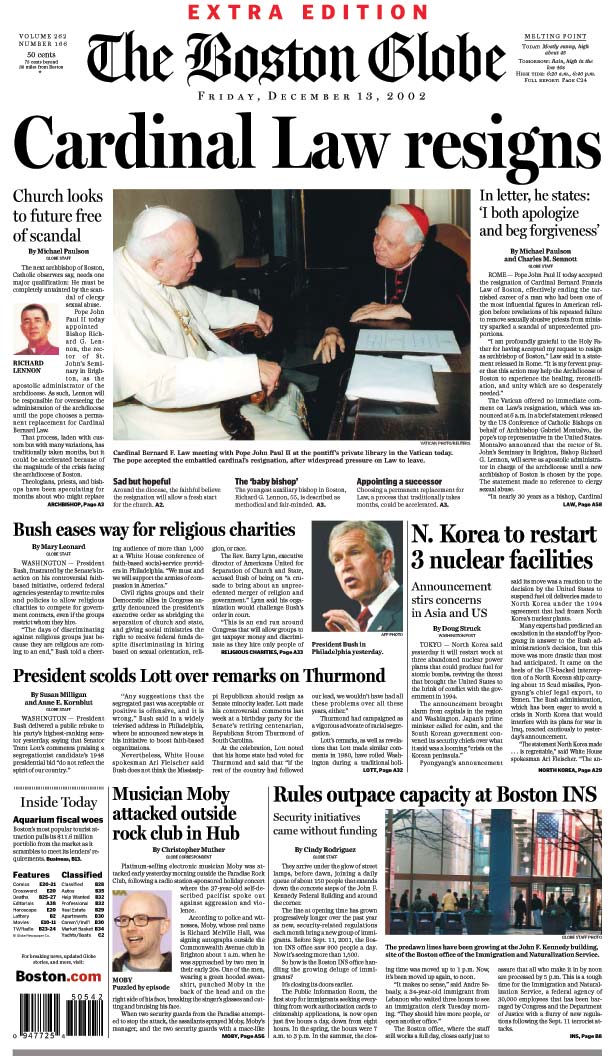
RT @jennamcjenna: thank goodness the Boston Globe is shutting down

From the Boston Globe itself comes notice that the New York Times Co., the corporation that owns the Boston Globe, is seeking bids from potential buyers of the Globe.

The well-publicized struggle between Globe unions and the NYTimes has been, for the most part, depicted as a David vs. Goliath kind of fight: The Globe, the scrappy little paper in the scrappy little city that could, against a big-time news conglomerate. In general, we like to root for the underdog, though it doesn't help that the Globe's largest of its four unions (editorial, advertising, and business office staff) voted against pay cuts after the other three unions--representing the largely blue-collar section of the paper--ratified major concessions in an effort to keep the paper open. Here's how the Globe article explains it:

In the last two weeks, three of the newspaper's four major unions -- representing the mailers, the pressmen, and the delivery truck drivers -- ratified concessions giving $10 million back to the Times Co. The Guild -- the paper's largest union representing nearly 700 editorial, advertising, and business office staff -- fell 12 votes short of ratifying another $10 million in concessions on Monday. However, the Times Co. said yesterday that it will get $10 million it needs from the Guild by imposing a 23 percent across-the-board wage cut, effective Sunday, the start of the next pay period.


I'm not, of course, actually glad to see the Globe get shut down. It means loss of jobs in a tight economy, and it may result in a kind of news vacuum, at least until reportage shifts to accommodate the gap. Even the fact that a second paper, the Boston Herald, covers city news won't stop this from happening. All the sources, all the politicians, public figures, public servants, and reading public that was loyal to the Globe won't suddenly defect; they're more likely to simply...kinda go away.

But as I've stated before, the traditional model of print journalism is unsustainable in a new media environment. The notion that all major cities need at least one major newspaper is no longer viable and, in lots of ways, no longer accurate. Papers once served as a community's glue, connecting people to each other when the community itself got too big for everybody to know everybody else.

Now we have lots of other new media outlets to glue a community together, and even the notion of "community" is no longer quite so bounded to geographical space.

Though we may not need or be able to support print newspapers, we absolutely still need journalism. It's time now to figure out how to harness the tremendous energy, enthusiasm, and brainpower of all the new media-journalist types by looking at how, why, and when they report on the news. It's time now to figure out how to support some sort of hybrid model that connects professional reporters with amateur (unpaid) journalists (brb plugging words linking to site http://jennamcwilliams.blogspot.com). It's time to move past the question of who killed newspapers. Journalism is dead. Long live journalism.

Tuesday, June 9, 2009

what's to become of local newsweeklies?

As I've mentioned elsewhere on this blog, I spent a handful of years as a print newspaper reporter. This was in the early years of this decade, before new media platforms posed the obvious and significant threat we're seeing locally, nationally, and internationally. Interestingly, though, two of the papers I worked for at the time--the Fenton Independent and the Holly Herald--folded during my tenure despite the dearth of new media technologies. The complex set of pressures that resulted in their closure exemplify the difficulties of keeping a local paper open even without too much competition. But that's a story for another day.


During those years, my editor was one Phillip Allmen, who currently runs the Milford Times, a print newsweekly owned by Hometown Communications, a local news conglomerate owned by Gannett, a larger news conglomerate. As a former employee of this group, I've been following the impact of the social revolution on these newspapers. Nothing drives home the thorniness of this issue like seeing a good editor and great reporter--Phil is both of these things--struggle to keep his newspaper and his job viable. On June 4, the Milford Times ran this editorial:

As many may have heard, the Observer & Eccentric closed its West Bloomfield, Troy, Rochester, Southfield and Mirror newspapers, with their final publication on May 31.

The Birmingham Eccentric was also on that list, but was revived to a once-a-week paper, after a groundswell of community support and pledges to boost subscriptions and advertising for that edition. It remains a “wait and see” proposition, but the company is willing to give it a try.

A South Oakland Eccentric paper will cover Southfield, Royal Oak, Ferndale and other south central Oakland County communities. The paper will be published on Sundays.

Many people are shocked and dismayed by the loss of the local papers. Many readers of the Milford Times have expressed relief that our paper remains open.

But, it can only survive with the support of the community.

We view the Times' long-standing relationship with the Huron Valley community a partnership. We depend on local advertising and home delivery subscriptions to survive. The community depends on the Milford Times to inform people about all aspects of the Huron Valley, from stories that affect neighborhoods and taxes to spreading the word about fund-raisers, special events and incredible people who do incredible things.

The Milford Times is the county's oldest, continuously published weekly newspaper. We've been around since 1871.

Just as we've promoted the “buy local” concept, in an effort to push local consumers to locally owned stores, we're urging folks to invest, to engage, in the Milford Times. Advertising budgets are tight, we know, and household budgets are also tight, but if we support each other, we'll make it through.

Here's what you can do to help the Milford Times. Urge merchants to advertise. Patronize local merchants who do advertise. Don't forget to tell merchants that you saw their ad in the Milford Times.

Purchase an annual subscription to the paper. The newspaper industry is in transition with print and online editions. But that transition is incomplete as newspapers search for a successful business model that will help sustain local information on the web. So if you read us free online that's fine, but it's important to pay for the print subscription — that's the only way we can afford to sustain that hyper-local Web site.

Each and every issue of the Milford Times contains items that support local causes, local events, local people. We're here to shine the light on the good, to evoke conversations, to support local businesses and to provide a forum for healthy debate on local issues that affect you. We want to be around for many years to come. You can help.

For subscription information, call (866) 887-2737 or for local advertising, call Sue Donovan at (517) 375-1369.


Readers of this blog know I'm fond of the Clay Shirky axiom that "it's not a revolution is nobody loses." In this case, local newspapers--and the communities that rely on it--are big potential losers. As Nieman Journalism Lab Director Joshua Benton pointed out in a recent BBC interview (lol I was part of the conversation too), the decline of print journalism means nobody's going to cover school board issues, community meetings, city council convenings and local elections.

I suspect Joshua and Phillip are right--I suspect that the loss of community newspapers will shift how, when, and why local events get covered. I'm at a loss here. I'd love to know what others think.

Thursday, June 4, 2009

things i've done for a living

because I subscribe to the "list" approach to blogging, because I subscribe to Jim Gee's notion of "shape-shifting portfolio people," and because it's high time for a short, self-absorbed post. Or, at least, for a self-absorbed post that's also short.


This is the list of things I've done for money, some of which I've also done for love.

key:
unionized employees
defunct
things i've also done for love
awesome
lame
n/a

  • blogger [the guardian]
  • curriculum specialist [project new media literacies]
  • outreach coordinator [project new media literacies]
  • billing coordinator [vca south shore animal hospital]
  • receptionist [vca south shore animal hospital]
  • adjunct instructor (composition, literature, creative writing, business
  • communications) [suffolk university, bridgewater state college, newbury college]
  • groundskeeper [city of fort collins, colorado]
  • graduate research assistant (composition, creative writing)[colorado state university]
  • writing tutor [colorado state university writing center]
  • administrative assistant [colorado poet laureate]
  • telephone operator [quest diagnostics]
  • reporter (sports, education, local politics)[holly herald, fenton independent,
  • spinal column newsweekly]
  • assistant director local nonprofit [public interest research group in michigan]
  • groundskeeper [city of grand rapids, michigan]
  • used book purchaser and seller [barnes & noble]
  • cashier [meijer, inc.]
  • receptionist [dean of students office, grand valley state university]
  • fast food employee (4 hours) [mcdonald's]
 

All content on this blog has been relocated to my new website, making edible playdough is hegemonic. Please visit http://jennamcwilliams.com and update your bookmarks!