Monday, January 18, 2010

technologies as sleeping policemen: or, how I learned to stop worrying and...

Nicholas Burbules and Thomas Callister worry for us. Or, at least, they were worried, over 10 years ago when they offered up their take on new technologies in a paper called The Risky Promises and Promising Risks of New Information Technologies for Education. Among their concerns: that too many people adopt a "computer as panacea approach" to new technologies. This is uniquely problematic in education, they argue, where
(r)ather than acknowledge the inherent difficulty and imperfectability of the teaching-learning endeavor, rather than accept a sloppy pluralism that admits that different approaches work in different situations—and that no approach works perfectly all the time—educational theorists and policy makers seize upon one fashion after another and then try to find new arguments, or new mandates, that will promote widespread acceptance and conformity under the latest revolution.

As problematic as the "computer as panacea" approach is, it pales in comparison to the relativistic "computer as neutral tool" approach, the one that has people saying that any technology can be used for good or for evil. Burbules and Callister explain that:

this technocratic dream simply errs in the opposite direction from the first. Where the panacea perspective places too much faith in the technology itself, the tool perspective places too much faith in people's abilities to exercise foresight and restraint in how new technologies are put to use; it ignores the possibilities of unintended consequences or the ways in which technologies bring with them inherent limits to how and for what purposes they can be used. A computer is not just an electronic typewriter; the World Wide Web is not just an on-line encyclopedia. Any tool changes the user, especially, in this instance, in the way in which tools shape the conception of the purposes to which they can be put. As the old joke goes, if you give a kid a hammer they'll see everything as needing hammering.

They prefer a middle approach, which assumes that a simple cost-benefit analysis fails to account for the possibility that benefits and costs are highly dependent on perspective. They offer as proof the history of antibiotics, which through widespread use greatly decreased humanity's likelihood of dying from bacterial infection but in the process led to the emergence of drug-resistant forms of bacteria. ("That is a very bad thing," they write.)

Though it's fairly simplistic to compare new information technologies to antibiotics, I'll go with the analogy for now, mainly because I agree with the authors' effort to problematize attitudes toward new technologies. It's perhaps more accurate to consider the social effects of antibiotics: they have led to a general increase in life expectancy, but in the process have enabled imperialistic societies (cf. the United States) to effectively colonize cultures, communities, and countries worldwide. In the same way, new technologies offer unprecedented access to information, communities, and tools for mobilization, but they simultaneously support new forms of colonization, both across and regardless of national borders.

Which brings me to the metaphor of technologies as sleeping policemen.

The sleeping policeman: In America, we call it a "speedbump." It looks like this:


The speedbump's intended effect is to get drivers to slow the hell down, and it's commonly used in neighborhoods and suburban areas with lots of kids. And it does get people to slow the hell down, primarily because they have no choice. There are also tons of unintended effects: Parents feel more comfortable letting their kids play outside. And, as this post points out, kids playing outside tend to get to know each other better. They--and, by extension, their parents--connect with other neighborhood residents, and everybody feels more connected: "Parents come to know the nearby children. And, inevitably, they come to know those childrens’ parents. They begin trading favors like driving children around. They become neighborly."

There are potential negative effects, too. Using sleeping policemen to slow drivers down changes driving practices in unintended ways. When a driver hits the last speedbump, she hits the gas and jets on down the road. This might increase the risk of an accident just beyond the range of the speedbumps. Drivers may choose to avoid areas with speedbumps, thereby increasing traffic through other areas--even, potentially, nearby neighborhoods whose streets lack speedbumps. And when a driver is not forced to monitor her own driving practices, the decision to simply drive more slowly in neighborhoods is taken away from her, thereby increasing the possibility that she will not adopt slower driving as a general practice.

Still, I think we can all agree that the benefits outweigh the costs. Nobody sees the speedbump as a panacea, and I don't imagine many people see the speedbump as a neutral technology.

So why do we worry so much more about the emergence and increasing ubiquity of new media technologies than we do about sleeping policemen or antibiotics?

One reason is that it's easier to see new media technologies as actors that shape our practices than it is to see how speed bumps and antibiotics have shaped us.

Actors: Any person or tool that exerts force upon any other person or tool, thereby shaping its use or practice. In Actor-Network Theory, everything is a potential actor, everything a potential actant.

Speed bumps act upon cars, drivers, kids, parents, neighborhood dynamics. Antibiotics have acted upon people, policies, government spending, and attitudes. We live longer now. We therefore reshape our lives, our goals, and our relationships to others. It's all very chaotic and complicated, because our reshaped attitudes in turn act upon our use of antibiotics. Everything mediates everything.

Because new media technologies have emerged and been adopted so quickly, their role in reshaping thought and action--and even, it's becoming clear, physiology--is clear, even if the outline of how this reshaping is shaking out remains quite fuzzy. New technologies as sleeping policemen: They shape not only how we drive, but how we think about driving. We move them, we reshape them, we add more or take a few away, we develop cars with better suspension...and it goes on down the rabbit hole.

Sunday, January 17, 2010

I'm kind of appalled by Clay Shirky

You may have read Clay Shirky's recent post, "a rant about women." You may also have read, heard, or participated in the chaos and conversation that sprung up around it. And rightly so, given this representative chunk of Shirky's post:
Remember David Hampton, the con artist immortalized in “Six Degrees of Separation”, who pretended he was Sydney Poitier’s son? He lied his way into restaurants and clubs, managed to borrow money, and crashed in celebrity guest rooms. He didn’t miss the fact that he was taking a risk, or that he might suffer. He just didn’t care.

It’s not that women will be better off being con artists; a lot of con artists aren’t better off being con artists either. It’s just that until women have role models who are willing to risk incarceration to get ahead, they’ll miss out on channelling smaller amounts of self-promoting con artistry to get what they want, and if they can’t do that, they’ll get less of what they want than they want.

There is no upper limit to the risks men are willing to take in order to succeed, and if there is an upper limit for women, they will succeed less. They will also end up in jail less, but I don’t think we get the rewards without the risks....

And it looks to me like women in general, and the women whose educations I am responsible for in particular, are often lousy at those kinds of behaviors, even when the situation calls for it. They aren’t just bad at behaving like arrogant self-aggrandizing jerks. They are bad at behaving like self-promoting narcissists, anti-social obsessives, or pompous blowhards, even a little bit, even temporarily, even when it would be in their best interests to do so. Whatever bad things you can say about those behaviors, you can’t say they are underrepresented among people who have changed the world.

There are enough smart people out there responding to this piece that I don't need to add more noise to the cacophony. But I do want to speak up as a dues-paying member of Women Who Run With The Arrogant Self-Aggrandizing Jerks And Sometimes Behave Like Arrogant Self-Aggrandizing Jerks Themselves.

Did I mention I'm a dues-paying member?

Because it's not easy to self-promote. It's not easy to stand up and say things that might be seen as stupid--or worse, dismissed because they come from a woman. It's not easy to announce to people "You should listen to me because I am awesome and the work I do is also awesome." It's not easy, in part because it takes extreme confidence (or at least something that looks to other people like confidence) to stand up and ask for attention, respect, recognition; and it's also not easy because the backlash is often so great, and simultaneously so subtle, that it sometimes feels like a one-step-forward, two-steps-back kind of deal.

My experience, in academia anyway, is that the tradeoff is this: If you want respect, authority, and platforms for broadcasting your ideas to a wider public, you have to self-promote; and if you succeed in gaining respect, authority, and platforms for speaking it's often at the cost of personal and professional relationships.

Let me say it more clearly: If you're a woman and you want to be heard, especially in academia, you have to knock on every door, announce your presence to everyone, and holler your qualifications at everyone in earshot. And if you do it right, people will hate you.

It will be harder to get daily work accomplished, because your colleagues will be stiff and formal with you. Male colleagues will challenge your knowledge and authority, and if that fails they will simply demean you in front of others. Female colleagues--and this is the really painful part--will shrink from you because in speaking so loudly, you've drowned out their voices. Some women, in an attempt to ally themselves with the people in charge, will also attempt to challenge and demean you.

(Another way to gain respect and authority, by the way, is to ally yourself with the people in charge, who in this case are primarily white guys. The backlash that comes out of this type of effort, though, is that you risk losing your place at the table the minute you misbehave. Then you have to come grovelling back, apologizing with downcast eyes, and take what scraps you can.)

Sure, men who self-promote risk hostility and resentment--but it's a different kind of hostility and resentment than what women experience. As members of the dominant cultural group, men who self-promote may be seen as a threat to specific people, but they certainly don't represent a threat to the established social order.

Women who are aware of the social positioning of women as a non-dominant group (and not all women are aware of this positioning, which is fine but sort of sad) develop a complex relationship to the decisions they make in crafting their public personae. They may engage in the kind of "arrogant, stupid" behavior that Shirky says is the best way to get ahead, but they do so knowing that some people (including, apparently, Shirky) will see this as "behaving more like men." They may choose to self-promote far less aggressively than Shirky would probably find useful, and to either accept that they will have trouble getting heard or find platforms for speaking where less self-promotion, less arrogance, is perfectly okay.

Or--and this is what lots of women, including me, do--they may adopt multiple identities, more identities, with more complicated politics, than those that men choose or are forced to adopt, in order to manage the competing demands on their behavior. This is not, lest I be misunderstood, the kind of identity cultivation that allows people to say "I have multiple identities! I'm an academic, and I'm also a mother, and I'm also a sister, and I'm also a friend." This is something much more complicated: It's "I'm this sort of academic-mother-sister-friend in this type of context, and I'm this sort of academic-mother-sister-friend in that type of context, and I'm this sort of academic-mother-sister-friend in that type of context with this person removed" and so on.

I don't quite know how to end this post, except to say that lots of people I like and respect think that Shirky is right on the money. And to add that my opinions are mine alone and not necessarily representative of all women, and that--and this is really important--I'm speaking from a position of relative privilege, since I'm a white, well-educated woman. I'm also thin, young, and not in any way physically disabled. I can't imagine how much more complicated this gets for someone who's even one step further removed from the dominant group than I am.

Monday, January 11, 2010

on ageism, sexism, and bad behavior: what we can learn from Dave Winer

Over at scripting.com, ageism is becoming an issue for Dave Winer.

Here's how it went down, in Winer's own words:

Earlier today I was listening to Talk of the Nation on NPR and heard an interview with Keli Goff from the Huffington Post. The interview started with an explanation that linked Reid's embarassing words (about Obama's race) to his age. She went out on a limb, way too far, although later in the interview she walked it back a bit.
This led to an afternoon of heated exchanges on Twitter. Lots of nasty stuff was said about people of my age, most of them untrue. What troubles me is that there is no general acceptance for insults based on race, religion or gender, but age-based insults have no taboo.

Dave Winer got attacked on Twitter today, no doubt about it. But what Winer doesn't point out here is that he gave as good as he got: He came out absolutely swinging, excoriating Groff and smacking back at anyone who disagreed with him, insulted him, or--and you can imagine the temptation was just too great for some of Winer's followers--notified him that he's too old to know what he's talking about. Here's a clip of Winer's twitter feed:


More than one person responded to Winer with some version of this:


I have to admit, it's kinda tough to disagree with @miniver.

Before I go on, I want to cop to my own bad behavior with respect to ageism: In the past, and on this very blog, I have offered up Rupert Murdoch as "further proof of why old people should not be allowed to run media conglomerates." That was blatant ageism, pure and simple, and it was wrong, and it's not okay, even when used as a rhetorical device. (In retrospect, I should have offered up Rupert Murdoch as further proof of why hopelessly avaricious people should not be allowed to run media conglomerates.) I am sorry. I promise to try harder from here on out to avoid such wrong-headed attitudes and discriminatory language.

Now then.

In some ways, ageism is similar to sexism in that it's brutally apparent to those who are the victims of it, even if others (non-victims) don't see how a person might take offense. (I imagine, but don't know for sure, that the same comparison could be made to other forms of prejudice--I'm just sticking with what I know best here and leaving the rest to others who know better than I.) People who react with anger to sexism, as to ageism, are treated like they just have their panties on a little too tight. "It's just a fact that women are better at raising children." "It's just a fact that older people don't understand the digital revolution." Both disempower the target. Both are destabilizing. And both are treated as socially acceptable in lots of situations where everyone should know better. (By the way, here's the mp3 of the Talk of the Nation conversation--Winer's right to take issue with what's clearly blatant ageism.)

Oh, but while I'm at it, I should also mention that women are exposed to sexism throughout their lives, so they're used to it and develop strategies for coping with it as it happens and afterward. But ageism is perhaps as startling and frustrating as it is for the simple reason that its victims are experiencing a prejudice that's entirely new to them. Of course, women who are the targets of ageism get hit with the double-disempowerment that comes with not only being female but being an old (read: asexual and therefore irrelevant) female. I can't imagine how the prejudice gets compounded when the target of ageism is nonwhite, nonstraight, or otherwise out of the mainstream.

Winer self-identifies as white and he's presumably straight (though a significant web presence has insinuated that he is, among other things, gay--about which more in a second), which perhaps explains his extreme outrage at the ageism directed straight at him today. (I agree with Anil Dash, who offered Winer this advice via Twitter:

@davewiner The way you are saying what you're saying is undoing the argument you're trying to make. Take a deep breath, come back in a bit.)


If you've rarely, or never, experienced the prick of arbitrary bigotry, then the first prick stings perhaps all the more deeply, scalds all the more powerfully. I still remember my first encounter with sexism, when my fourth grade teacher told me I couldn't climb the playground swingsets to unwind the swings because I was a girl. It never gets less galling. It's just that we do our best to get better at responding, in word and in deed. The fourth grade me, surprised, gave in and went inside. The 32-year-old me, by contrast, might climb the swingset anyway, in direct defiance of her teacher. (The 32-year-old me may, incidentally, actually be worse at getting what she wants.)

There's a side note to this story, an interesting one: Dave Winer apparently carries a reputation for bad behavior in online communities. I didn't know this until this evening, when I started researching Winer's backstory for this post. I started following him on Twitter because of his status as a pioneer in weblogging, and until today knew next to nothing else about him. But here's a sample of what I learned about how Winer responds to criticism:
  • Software developer and writer Mark Pilgrim decries Winer's propensity for personal attacks against those who criticize his work (here's What's your Winer number? an algorithm for determining how your experience of Winer's verbal abuse compares to the experiences of the hordes of others who have fallen victim to it, and here's a post where Pilgrim makes public Winer's response to the Winer number post--take a look at Winer's comments below the post).
  • Here's Matthew Ingram on Winer's response to public criticism of a post Winer wrote called "Why Facebook Sucks." When Stowe Boyd disagreed with Winer's post, Ingram writes, Winer apparently called Boyd "a creep" and "an idiot."
  • Here's Jason Calacanis, who names Winer as a friend but still offers his experience of "getting Winered" during a public presentation.

The list goes on. The ridiculous "gay" insinuation--well, that sort of bad behavior is what people resort to when they feel people in positions of power are acting in violation of the public trust--when they see arrogance, pettiness and rudeness from someone who has no reason to act so poorly.

There are at least two lessons to draw from the Winer / ageism story: First, that the worn grooves of prejudice and discrimination are so, so easy for humans, flawed as we are, to fall into, and that it is our responsibility to guard against taking that easy path; and second, that bad behavior in communities of practice is still not okay, no matter who you are. The difference these days, of course, is that reputation not only precedes you but follows behind you like a little yipping terrier. It's getting harder and harder to walk into a room you've never entered without everyone noticing the constant bark of that little dog.

Saturday, January 9, 2010

smacking down Jaron Lanier & 'World Wide Mush'

Normally, I wouldn't take on such a revered, well credentialed authority as Jaron Lanier,* but his recent Wall Street Journal piece on why the movement toward collectivism, collaboration, and openness is doomed to failure leaves him cruising for a bruising.

"Most people know me as the 'father of Virtual Reality technology'," Lanier announces. (This boast is repeated in his presumably self-crafted or at least author-approved bio at the bottom of the article.) He was also, however,
part of a circle of friends who tried to imagine how computers would fit into the peoples' lives, including how people might make a living in the future. Our dream came true, in part. It turns out that millions of people are ready to contribute instead of sitting passively on the couch watching television. On the other hand, we made a huge mistake in making those contributions unpaid, and often anonymous, because those bad decisions robbed people of dignity. I am appalled that our old fantasies have become so entrenched that it's hard to get anyone to remember that there are alternatives to a framework that isn't working. 
 The "mistake" of making participation in online communities free and unpaid is only the first half of Lanier's frustration. He also hates what he calls the "collectivist" nature of online communities:
Here's one problem with digital collectivism: We shouldn't want the whole world to take on the quality of having been designed by a committee. When you have everyone collaborate on everything, you generate a dull, average outcome in all things. You don't get innovation.

If you want to foster creativity and excellence, you have to introduce some boundaries. Teams need some privacy from one another to develop unique approaches to any kind of competition. Scientists need some time in private before publication to get their results in order. Making everything open all the time creates what I call a global mush.
Lanier's first mistake is treating Wikipedia culture--or, as Stephen Colbert puts it, Wikiality--as a stand-in for all forms of collective problem-solving. Lanier of all people should know that the often anonymous, often trivial and often problematic Wikipedia model is only one approach to collaboration, and one that works--and often works very well--for fairly low-stakes and longer-term goals. You don't cite Wikipedia in a White House briefing on Islam in Nigeria, for example, but you do cite Wikipedia in proving to your brother-in-law that Breakfast at Tiffany's was released just at the very beginning of the 1960's, just like you said it was. (Did you get that, Dean? 1961.)

Lanier also finds Google Wave problematic because he sees it as another iteration of wikiality; it "encourages you to blur personal boundaries by editing what someone else has said in a conversation with you, and you can watch each other as you type so nobody gets a private moment to consider a thought before posting.

"And if you listen to music online," he continues, "there's a good chance your listening will be guided by statistical analysis of Internet crowd preferences."

Ultimately, I suppose, and in true Wikipedia form, we all get the reality we expect to perceive. Lanier, in his mistrust of collective action, zeroes in on specific communities and specific features of specific resources that he believes prove that collectivism is a terrible, dehumanizing mistake. Along the way, he ignores the vast variety of successful projects of collective action, including:
  • This year's DARPA challenge winners, based out of Sandy Pentland's Human Dynamics Laboratory at MIT, who successfully crowdsourced the search and retrieval of 100 red balloons hidden across America in a flabbergasting 8 hours and 52 minutes (researcher Riley Crane points out that while the balloons themselves were an arbitrary target, the process by which the balloons were retrieved might be applicable to more significant social problems);
  • The recent Netflix Prize, which crowdsourced the development of a more accurate system for identifying Netflix members' potential interests based on previous titles viewed;
  • And, oh yeah, the entire open source software movement, starring Linux, WordPress, Mozilla Firefox, Ubuntu, and a host of lesser characters playing supporting roles.

And those are just the easily identified successes of collective action. It's more challenging, but equally important, to identify and champion local or concentrated examples of collective action. When people learned of a proposed bill in Uganda that would legalize execution of homosexuals, they spread the word. Bad press for any country, even worse when prominent Americans appear to be involved behind the scenes. Video of Rachel Maddow brutally smacking down "ex-gay" evangelist Richard Cohen, suspected to have worked in support of the law, was viewed nearly 60,000 times on YouTube. While the bill is moving forward through Uganda's Parliament, the international outcry makes it more likely that a.) the law, if passed, will go largely unenforced; b.) international relations with Uganda, with governments or NGOs, will be strained; c.) any other country interested in passing a similar law will think twice about garnering such negative press; and d.) prominent anti-gay American politicians and evangelicals will think twice about joining up with a similar cause.

Over on Twitter, Dean Shareski announced he had been charged hundreds of dollars by his cellphone carrier when his daughter began texting new friends without adding them to the company's My5 plan. As he explains in a recent post, Twitter saved him $764.13: His tweets about the issue were retweeted by followers, and the company noticed and erased the extra charges.

Small and large, the possibility for collective action is empowering people to resist injustice, call for change in politics in attitudes, develop new tools to improve human lives. You don't get innovation? You can't foster creativity? I say bollocks to that.

Now for the second part of Lanier's argument, that the model of unpaid contribution has led to a general decline in quality and social and technological progress. He writes:
The "open" paradigm rests on the assumption that the way to get ahead is to give away your brain's work—your music, writing, computer code and so on—and earn kudos instead of money. You are then supposedly compensated because your occasional dollop of online recognition will help you get some kind of less cerebral work that can earn money. For instance, maybe you can sell custom branded T-shirts.

We're well over a decade into this utopia of demonetized sharing and almost everyone who does the kind of work that has been collectivized online is getting poorer. There are only a tiny handful of writers or musicians who actually make a living in the new utopia, for instance. Almost everyone else is becoming more like a peasant every day.
Yeah, sure, the economics of creativity are shifting--but what Lanier sees as a kind of serfication of the creative class (what? really? really? really?) others see as an equitable redistribution of socially valuable goods. John Brockman reminds us of the words of McLuhan himself:

McLuhan had pointed out that by inventing electric technology, we had externalized our central nervous systems; that is, our minds. (John) Cage went further to say that we now had to presume that 'there's only one mind, the one we all share.' Cage pointed out that we had to go beyond private and personal mind-sets and understand how radically things had changed. Mind had become socialized. 'We can't change our minds without changing the world,' he said. Mind as a man-made extension became our environment, which he characterized as 'the collective consciousness,' which we could tap into by creating 'a global utilities network.'

If you believe we are all part of one social mind, the world's mind (and remember that we get the reality we expect to perceive),  then it follows that the segmenting off of important ideas, the claiming ownership over ideas, the holding them separate from the rest of the social mind is the worst kind of sin: It is relentless and causeless self-abnegation, a sin against oneself.

It's true that some of the contributors to some of the projects I list here were paid for their participation; but they were paid for their time, and not for their ideas.  The rewards for joining in a collaborative effort are not, despite Lanier's assertion to the otherwise, reduced to either praise or money; the rewards are in contributing to a socially meaningful activity, in being a productive part of something larger than oneself.  Indeed, Lanier's very argument that "millions of people are ready to contribute" but that they are ready to do so even though their contributions are "unpaid, and often anonymous" shows that kudos or money are not the only motivators in collaborative spaces.

I'm an intermittent contributor to Wikipedia, and I do it without the expectation of money or kudos; I do it knowing nobody knows or cares about my contributions, except that what I add makes something neat a tiny bit better than it was before. There's value in that, to me and to the hordes of people who are perfectly comfortable contributing to collaborative projects anonymously and for free. Some things we do for money, after all, and some we do for love.


*jk jk jk I have absolutely no problem taking on such a revered, well credentialed authority as Jaron Lanier.

Tuesday, January 5, 2010

on Cory Doctorow on how to say stupid things about social media

"There are plenty of things to worry about when it comes to social media," says writer Cory Doctorow in his fantastic Guardian piece, "How to say stupid things about social media." Social media environments, he continues,
are Skinner boxes designed to condition us to undervalue our privacy and to disclose personal information. They have opaque governance structures. They are walled gardens that violate the innovative spirit of the internet. But to deride them for being social, experimental and personal is to sound like a total fool.
Yet plenty of perfectly smart people who should know better say exactly the foolish kinds of things Doctorow rightly decries in his post. Mainly, lately, the stupid things have been leveled at Twitter: It's trivial. It's banal. It's too voyeuristic, or it's a weak imitation of real relationships, or--and this is the one that really gets me--I try to use it in smart, deliberate, consequential ways, even though lots of my followers don't.

Partially, people who take stances like the above fail to see that the majority of the communication on sites like Twitter falls into the category of what Doctorow calls "social grooming." He writes:
The meaning of the messages isn't "u look h4wt dude" or "wat up wiv you dawg?" That's merely the form. The meaning is: "I am thinking of you, I care about you, I hope you are well."
Doctorow compares the "banality" of conversations on Twitter and Facebook to the conversations we have with coworkers. We ask a coworker if she had a good weekend, he writes, not because we care about how her weekend went but because we care about developing bonds with the people around us.

Yes, though that's only part of the answer. In choosing to communicate via Twitter, I'm not only saying "I am thinking of you, I care about you, I hope you are well," but I am also publicly announcing: "I am thinking of him, I care about her, I hope he is well." These announcements are interspersed with my Twitter interactions with
people who are not close friends or even necessarily acquaintances--people I care about only in the most abstract sense. I follow just under 350 people, after all, and am followed by around the same number--a far higher number than I am equipped to develop deep relationships with. And lots of people follow and are followed by far greater numbers than I.

The creaming together of the personal and the professional, the public and the private, means that 'trivial' social interactions in online social networks, however much they seem to replicate those that pepper our physical interactions, actually represent a new social animal whose form we have yet to fully sketch. We're all kind of blindly feeling our way around the elephant here. We who embrace social media technologies can scoff at the person who says an elephant is like a water spout after feeling only its trunk, or the person who has felt a little more and argues it's like a moving pillar topped off by a shithole, but we would do well to remember that in this parable, everyone who tries to describe the elephant, no matter how much of it he has touched, can only describe it by comparing it to objects he has previously encountered. Twitter is similar to a lot of things, but in the end it's its own elephant, identical to nothing else we've seen before.

This is why, as Doctorow points out, people rely on personal experience and therefore read Twitter and similar networks as trivial and banal instead of deeply socially meaningful. But it's also why we need to take care to treat the social meaning as different from that which emerges through other types of (digital or physical) social interactions.


Monday, January 4, 2010

the sleeping alone review of films: Avatar (3D)

summary: holy effing effety eff.


Avatar 3D: Holy effing effety eff. That is all.

Click here to find showtimes for Avatar at a theater near you.

Sunday, January 3, 2010

the sleeping alone review of films: The Curious Case of Benjamin Button

summary: Just cut out the middle man and watch Forrest Gump instead.

It’s a strange but true fact that I’m far more likely to post a review of a film I didn’t like than I am to post one of a film I enjoyed. There are, she protests, lots of reasons for this, but that’s a blogpost for another day. Right now I just want to tell you why The Curious Case of Benjamin Button is such a bad, bad movie.

I finally climbed aboard the Benjamin Button bandwagon in the dead week between the Christmas and New Year’s holidays. Since I’m not all that into wistful, you-can-do-it love stories, I was mainly motivated by a desire to see how the filmmakers dealt with the movie’s main conceit: A protagonist who ages backward, Mearth-style.


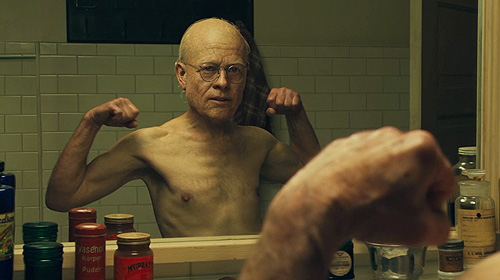
To the film’s credit, it refuses to shy away from the most potentially ridiculous aspects of this conceit. It’s as brazen in pointing an old-man-baby at the camera as it is in presenting, near the end of the film, a literally baby-faced old man. It does appear that we’re getting better at artificially aging people, too: Benjamin, played with consistent age-appropriate physicality by Brad Pitt, never once looks like a young, handsome man coated in plastic, which is what we've come to expect from any prematurely aged actors after decades of bad special effects. When the 20-something (but 60-ish-looking) Benjamin has an affair with a 40-something woman, he is depicted pitch-perfectly as a thin-haired, disheveled and declining man whose smile belies a boyish inner youth. The affair, and those that follow with comparatively younger women, seem to flow naturally from the radiance, youth, and energy that shine from Benjamin’s eyes and smile, if not his skin.


If you set aside the special effects, though, there isn’t much left. The plot is assembled around so many layers of unnecessary meta-story that the resulting mass of MacGuffins end up feeling like a combination of pointless distractions and the unfortunate side effects of a poorly adapted novel. There’s an ancient lady dying in a hospital as a major hurricane threatens its landfall. There’s the woman’s prodigal daughter, who has apparently returned home at the last minute to say her goodbyes. There’s a blind clockmaker, white, who marries a black Creole woman and whose only son is killed in a far-off war, and who therefore decides to build a clock that runs backward. He gives a short speech about wanting to turn time backwards, then he disappears, god knows why. There’s the black woman who raises Benjamin as her son, and who spends her entire working life employed at a retirement home, god knows why. And there’s a diary, penned by Benjamin Button, which is introduced as his Last Will and Testament. God knows why.

Now: organize all of the above details in order of novelty and interest, then cross off all but the two or three most boring and clichéd and you end up with the only details that actually end up mattering. Then, on top of the hot mess that presents itself as plot, there’s a lengthy and confusing mini-story wherein Benjamin travels by tugboat to Russia, meets a British woman whose husband is a spy, kind of falls in love with the woman and, it appears, carries on a kind of tepid affair of indeterminate length that ends for a vague set of reasons. The sole purpose of this entire intermission appears to be to shoehorn Tilda Swinton into the cast. Which, fair enough. But as my mom put it, It’s…kind of a long movie as it is.

So there you have it: Cool-ish special effects; confusing, slow, overcomplicated and irritatingly intricate plot. Add one more negative: In this film, people are treated as nameless diversions, as things that happen to people to advance the story. Early in the movie, an elderly resident of the old people's home tells Benjamin "We're meant to lose the people we love. How else would we know how important they are to us?"

Not only is the quote itself inane--love is deepened and refined by the inevitability of loss, but saying we're meant to lose people so we may know how much we love them is putting the cart miles before the horse--but the movie doesn't even care to try to bear this limp aphorism out. Characters come and go, flowing through Benjamin's life like a river, and it's never clear that the loss of any one of them is any more painful to him than the loss of any other. In fact, Benjamin seems to actively avoid developing deep relationships with people, and at a crucial moment he even walks away from someone he loves instead of having to deal with loss. Indeed, Benjamin himself muses that "It's funny how sometimes the people we remember the least make the greatest impression on us." In what universe could that even be possible?

This is a movie that wants it both ways: It wants us to believe that our lives are characterized by the people we love deeply, and it wants us to believe that our lives are characterized by how they are shaped by the people who flow across our paths like buffeting wind--all of them different and finally the same, not a one distinct from any other.

In the end, though, Benjamin Button's biggest crime is that it tries too hard to be Forrest Gump. But Gump did it better: neater special effects, tighter plot, better character development. And lest Forrest be accused of treating people like nameless diversions, I offer the following: Forrest’s excuse was his IQ. And besides, no matter how Forrest thought of the people who flowed through his life, there was always, for him, Jenny. We love Forrest, we root for him, because he loves Jenny, he pines for Jenny, he comes up with ways to pass the time until he can see Jenny again. Benjamin has Daisy, who this film would very much like to convince us is the deep and lasting, abiding love of his life. But at the risk of spoiling the movie, she’s really not. She's another diversion, another way to pass the time, another thing that happens to Benjamin. We're supposed to believe that Benjamin is the hero of the story, but in fact Daisy proves herself to be strong, resilient, flawed but kind. In other words, she's complex and layered, like all good movie heroes should be. Benjamin is flat and shiny, kind of like...a button, I suppose.

Daisy might very well be more of a hero than Jenny, but Benjamin is no Forrest. And this film, despite what you may have heard to the contrary, is not Oscar material.
 

All content on this blog has been relocated to my new website, making edible playdough is hegemonic. Please visit http://jennamcwilliams.com and update your bookmarks!